
The $3.7 Trillion Customer Service Problem Nobody Wants to Talk About
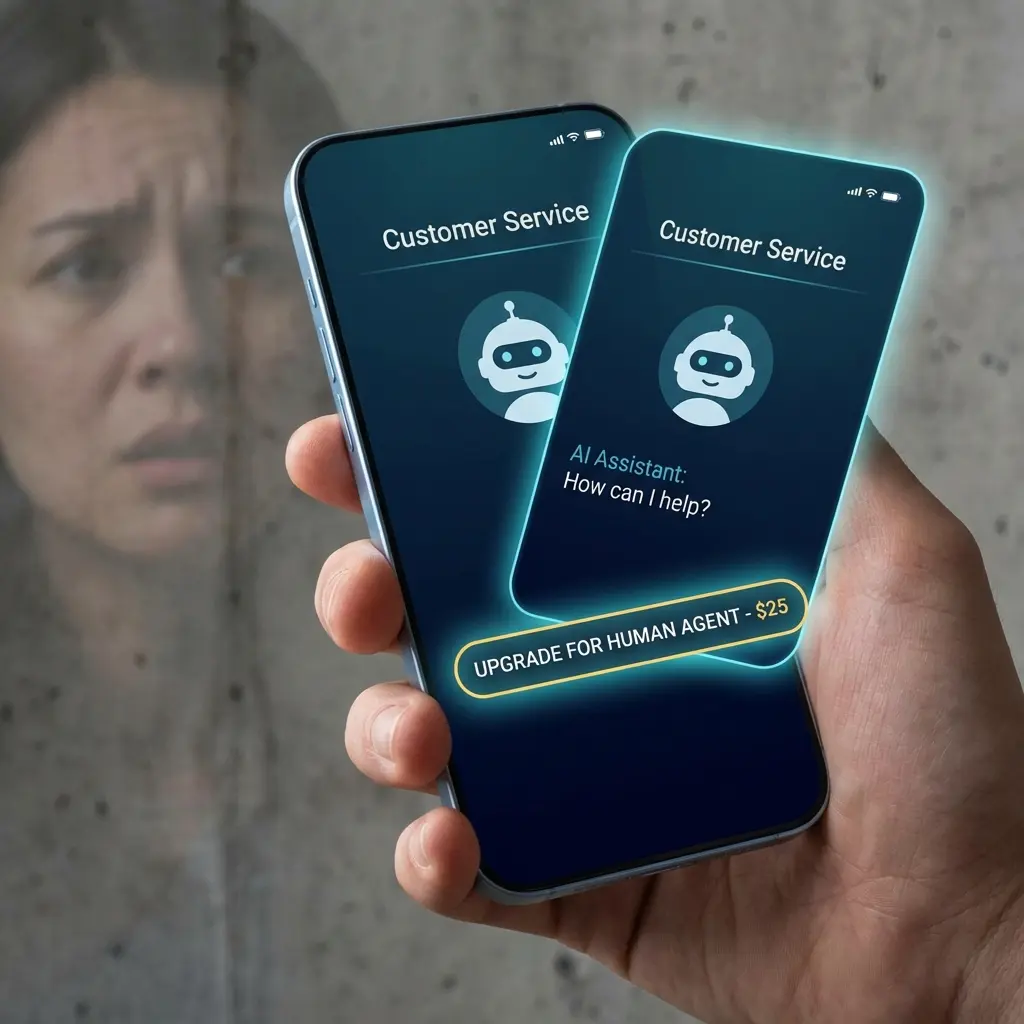
Apparently talking to a human is now a premium feature.
I hit a DNS error last week. The site told me to contact customer service, but there was no actual way to do that. Instead, I got stuck in an AI chatbot loop, sent to FAQs that didn't help, pointed to forums, then finally—after 30 steps—found a ticket form. Never heard back.
But hey, they did offer me an upgrade to "dedicated service" if I paid extra.
So let me get this straight: you know your AI can't help me, but if I pay you more money, you'll give me what should've been standard in the first place?
The Human Premium Tax
This isn't just my frustration. It's becoming the norm. Companies are charging anywhere from $7 to $25+ just to connect with a real person. Three-quarters of Americans say they'd pay more for customer service that lets them skip AI entirely.
We've literally turned empathy into a luxury product.
And it's backfiring spectacularly. Poor customer service is costing businesses $3.7 trillion annually. After a bad experience, 51% of customers reduce or stop spending with that company. Another 57% just switch to a competitor.
The math is brutal: you save money on support staff, but you lose customers. You cut headcount, but you increase churn. You automate empathy, but you destroy trust.
Where AI Actually Works (And Where It Doesn't)
I'm not anti-AI. I use it every day. It's brilliant for automated data scraping, sorting through massive datasets, handling back-office operations—anything that's not customer-facing.
But customer service is different. It requires empathy, context, and complex problem-solving. It requires understanding that when someone's stuck with a technical error blocking their work, they need help now—not a 30-step maze.
AI can't do that. Not yet. Maybe not ever.
The data backs this up: nearly one in five consumers who use AI for customer service see zero benefits. That's a failure rate almost four times higher than AI use in general. 75% of customers feel chatbots struggle with complex issues and fail to provide accurate answers.
When your automated system has an 83% failure rate on billing issues, you don't have an efficiency solution. You have a customer retention crisis.
The Real Question for Business Leaders
If you're deploying AI across your organization, ask yourself this: are you using it to enhance customer experience, or to cut costs while degrading service?
There's a massive difference between those two scenarios.
Using AI to automate invoice processing? That enhances efficiency without touching the customer relationship. Using AI to handle customer complaints? That replaces human connection at the exact moment people need it most.
Here's my take: if your AI actually worked for customer service, you wouldn't need to charge extra for human support. The fact that premium "human access" tiers exist is an admission that your baseline system fails.
What This Means Moving Forward
I'm not suggesting you abandon AI automation. I'm suggesting you get honest about where it belongs.
Audit your customer touchpoints. Identify the moments when people are confused, stuck, or frustrated. Those are the moments when AI will fail you.
Because your customers already know when you're using AI to improve their experience versus when you're using it to cut costs. They're the ones jumping through 30 steps to submit unanswered tickets. They're the ones seeing the "upgrade for human service" option and realizing you've put basic support behind a paywall.
And they're the 57% who will leave the moment they find better service.
AI automation is a powerful tool. But customer service isn't the place to run cost-cutting experiments. It's the place where you prove you value the people who pay you.
Get that wrong, and no amount of automation will save you from a $3.7 trillion problem.
Related Blogs

Got Kicked Out of GroupMe? Look to Evant.
Michael PedoeemGot Kicked Out of GroupMe? The Best GroupMe SMS Alternative for Jewish Communities

How to Send Targeted Alerts During Live Events
Michael PedoeemMastering Targeted Event Alerts: Real-Time Communication Strategies for Nonprofits
Top 7 SMS Trends for Communities in 2026
Michael PedoeemFrom AI-powered responses to text-to-donate and two-way texting — here are the 7 SMS trends every shul, school, and nonprofit needs to know about in 2026