
The Volunteer Engagement Gap and the Texting Solution
Most churches struggle with a simple reality: they rely on broad, passive announcements to fill critical roles. A pastor makes an appeal from the pulpit or sends a mass email, but the message is either ignored or lost in the noise. This approach is akin to shouting into a windstorm and hoping to be heard.
The gap between a need and a filled position often stems from a lack of personal connection. In contrast, evant.app transforms this outreach by moving from mass broadcasts to direct, one-on-one communication. While traditional email open rates hover near 20%, SMS communication achieves a 98% open rate, with most messages read within 90 seconds of delivery.
This speed is a game changer for volunteer management. By using evant.app to coordinate teams, leaders can shift from scrambling at the last minute to building a reliable, automated rhythm of recruitment, scheduling, and appreciation. This section explores how to bridge the engagement gap by utilizing targeted text messaging to build a more responsive and committed volunteer culture.
Personal Invitations Beat Pulpit Announcements
Most churches struggle with a simple reality: they rely on broad, passive announcements to fill critical roles. A general plea from the pulpit for help is rarely enough to turn a spectator into a servant. When you shout into the crowd, you get lost in the noise.
The secret to real growth is shifting from mass broadcasts to direct, one-on-one invitations. This personal approach is exactly how Grace Church in Erie, Pennsylvania, sustains a volunteer-driven staff, by treating high-capacity leaders with professional expectations and casting a clear vision for their role.
Generic outreach often fails because it ignores the individual. With evant.app, you can move beyond this inefficiency. By using segmentation, you can group members by their ministry interests or service history rather than treating your entire database as a monolith.
Scaling this level of intimacy is difficult without the right tools. Platforms like evant.app allow you to use personalized tags, such as a contact's first name, in every outgoing text. This makes an automated message feel like an intentional, private conversation rather than a mass-market blast.
When you replace a vague Sunday morning request with a direct, specific text invitation, you demonstrate that you value a volunteer's unique gifts. This is how you bridge the gap between people being aware of a need and actually stepping forward to meet it.
Timely Automation Builds Reliability and Trust

Managing volunteer shifts with manual spreadsheets or email threads is a losing battle. You send a reminder, it gets buried in a crowded inbox, and by Sunday morning, you are scrambling to fill empty stations. Using evant.app changes that dynamic by moving logistics into a channel where 98% of messages are read within three minutes.
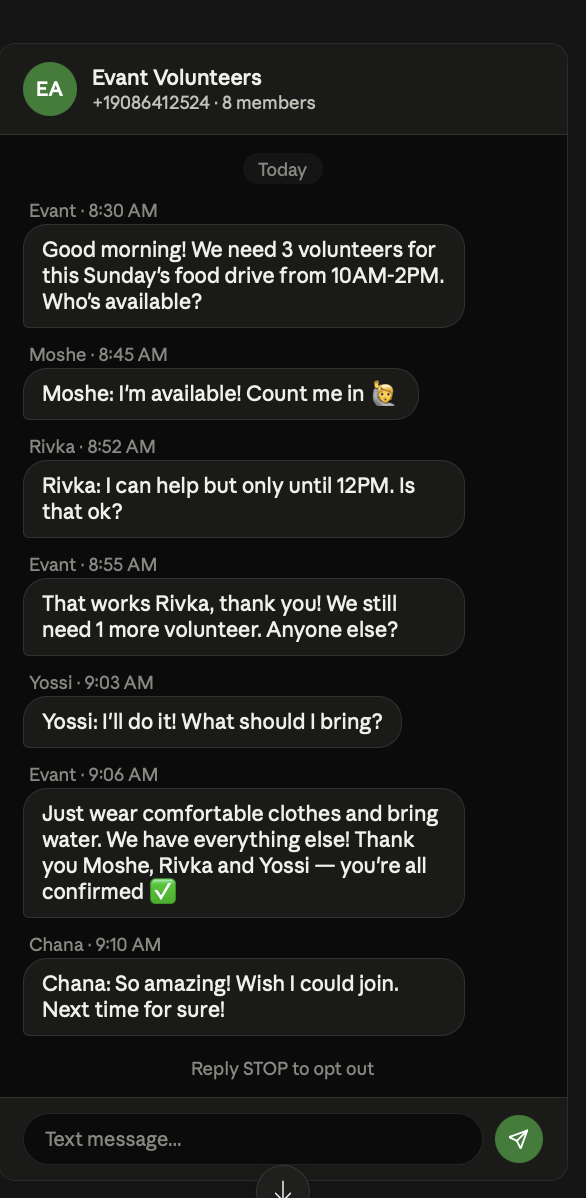
Reliability begins with structured, automated workflows. By setting up calendar-based triggers, you ensure volunteers receive clear instructions, shift details, and logistical updates precisely when they need them. Instead of waiting for a manual check-in, these automated sequences handle the heavy lifting, allowing volunteers to signal unavailability in real-time. This early warning system lets your team pivot long before the event starts, rather than discovering gaps at the last second.
- Automate the full event sequence: send a Save the Date notice, a two-day reminder, and a final nudge on the day of the event.
- Use two-way messaging to enable instant confirmations, allowing volunteers to report scheduling conflicts so you can reassign roles immediately.
- Deploy emergency alerts for urgent facility issues or last-minute shifts to ensure your team stays informed and prepared.
- Boost retention by triggering a personalized thank-you message within 24 hours of service, referencing specific contributions to demonstrate that their effort was noticed.
This level of automation does more than just fill spots. It builds trust. When volunteers know they will receive timely, accurate info via evant.app, they feel more confident in their commitment. By reducing the administrative burden, you stop treating volunteers like resources to be managed and start treating them like valued partners in your mission.
From Onboarding to Retention: The Volunteer Lifecycle
Moving a person from a casual attendee to a reliable volunteer requires more than a single announcement. The most effective churches treat the onboarding journey as a deliberate, systematic process rather than a random series of requests. When you automate the initial connection, you remove friction that often leads to drop-offs.
Using evant.app allows you to capture interest instantly through text-to-join keywords, digital connection cards, or simple QR codes on service slides. These tools feed directly into a CRM, ensuring no potential volunteer slips through the cracks. While manual systems rely on static spreadsheets, evant.app automates the follow-up, ensuring every new recruit receives a clear job description and an invitation to an orientation tour.
Building Lasting Commitment
Once a volunteer joins, the four-week apprenticeship model helps them build confidence. Week one, they watch. Week two, they assist. By week three, they lead with your support, and by week four, they own the role. During this time, constant clarity is essential. Sending specific responsibilities via SMS keeps expectations aligned and reduces anxiety for new leaders.
- Use segmentation to target volunteers by ministry, skill, or age group, preventing information overload.
- Schedule automated check-ins to share wins and gather feedback, which keeps volunteers feeling connected to the mission.
- Ensure senior leadership sends personal appreciation texts to reinforce that their time and effort are genuinely valued.
Retention is ultimately about making volunteers feel seen. Relying on impersonal mass emails often leads to burnout, whereas evant.app enables personalized, two-way conversations. By tracking engagement and automating regular check-ins, you maintain a healthy culture where every participant knows their impact matters. Proper SMS compliance ensures you maintain trust with your congregation while scaling these outreach efforts.
Reducing Churn Through Two-Way Relationship Building

Most community leaders try to fix volunteer turnover by sending more emails. They assume that if they just reach out more often, people will feel more connected. The reality is that email inboxes are graveyard zones where communication goes to die. SMS marketing cuts through that noise, with roughly 98% of messages read within minutes, offering a direct lifeline to your congregation that email simply cannot match.
The true power of a platform like Evant.app lies in its ability to move beyond simple broadcast alerts. While traditional mass-texting services often treat recipients as a cold list, Evant.app enables two-way conversations that mimic authentic human connection. This allows volunteers to reply directly with questions about their shifts, share personal prayer requests, or offer feedback on event logistics without the friction of a separate form or a delayed email thread.
Churn often happens in the silence between events. By using segmented lists, you can treat a first-time guest with a different, more personalized cadence than a seasoned volunteer. You can automate stewardship check-ins that remind them of the impact of their service, connecting their specific role to the broader mission of the church. This kind of intentionality prevents the drift that precedes disengagement.
Compliance remains a critical aspect of building this trust. Following SMS compliance standards ensures that your efforts to stay in touch are viewed as a value-add rather than an intrusion. By maintaining a clean, opt-in based database, you protect the sanctity of the relationship, ensuring that your community feels respected and valued rather than like just another entry in a spreadsheet.
Digital Tools Streamline Event Logistics
Many church leaders still manage events with a disjointed collection of paper sign-up sheets and email threads. This manual approach creates a logistical bottleneck that prevents staff from focusing on the people they are trying to serve. When information is siloed across different spreadsheets, tracking real-time capacity or following up with attendees becomes nearly impossible.
By centralizing registration and check-ins within a platform like evant.app, organizations can automate the entire attendee lifecycle. Instead of manual data entry, event participants can use SMS-based RSVPs to register instantly. Automated confirmation messages then provide immediate peace of mind for the attendee while populating the church database automatically.
How do digital event management tools streamline logistics for church and nonprofit events?
These systems function as a digital safety net for event planning. Automated reminders sent via SMS significantly reduce no-show rates, ensuring that energy spent on preparation translates into actual participation. Unlike generic email blasts that often go unread, these targeted texts reach congregants in their most active communication channel.
Integration with existing Church Management Software (ChMS) ensures that all attendee data remains synced and actionable. This connectivity allows leaders to monitor real-time tracking for capacity management and pull analytics on attendee behavior after the event concludes. While platforms like Text in Church provide basic messaging, evant.app distinguishes itself by coupling these SMS capabilities with deeper CRM integration to build long-term engagement loops rather than just processing one-off events.
Choosing the Right SMS Platform for Your Church
Selecting an SMS platform for your church is about more than just finding a way to send bulk messages. Many churches start by trying to use personal phones or basic messaging apps, but those lack the necessary SMS Compliance Basics that protect your organization from significant legal risks under the Telephone Consumer Protection Act. If you want to move beyond manual spreadsheets, you need a system that handles compliance automatically.
When you compare generic messaging tools against a dedicated solution like evant.app, the difference often comes down to integration and workflow. While generic platforms might offer basic mass texting, evant.app provides deep CRM integration and automated workflows designed specifically for faith-based event management. This means your volunteer lists stay synced and your event reminders trigger without someone manually hitting send.
Must-Have Features for Modern Outreach
- Automated Workflows: Look for platforms that can trigger follow-ups based on specific user replies, ensuring no volunteer or guest falls through the cracks.
- Compliance Architecture: Ensure the platform supports A2P 10DLC registration, which is now a standard requirement for ensuring your messages actually get delivered by mobile carriers.
- Two-Way Communication: Unlike simple broadcast tools, a robust platform enables one-on-one conversations so volunteers can ask questions or report scheduling changes in real-time.
- Detailed Analytics: A professional dashboard allows you to track engagement metrics like response rates and click-throughs, helping you decide which messages resonate and which lead to opt-outs.
- Scalability: Whether you are a small parish or a multi-campus ministry, the system should grow with you without requiring you to switch tools or re-import your entire contact database.
Platforms like evant.app also simplify the complexities of donor management by enabling text-to-donate features directly within the messaging flow. This unified approach prevents the fragmentation that often plagues churches using separate tools for events, volunteers, and giving. By choosing a platform built for community engagement rather than just marketing, you gain the ability to foster a thriving volunteer culture where communication is clear, reliable, and deeply connected to your mission.
Overcoming the 80% Attendance Plateaus with SMS
The 80% rule suggests that when a church's average attendance reaches 80% of its seating capacity, the facility feels full to the average person, creating a psychological barrier that often stunts further community growth. Rather than being defined by fire code limits, this threshold is rooted in the human need for personal space and comfort, which dictates that congregations experience a perceived lack of room long before every seat is occupied. When a space feels crowded, visitors are less likely to return, often leading to a growth plateau that persists until the constraint is addressed.
While this rule primarily concerns worship and education spaces, it serves as a critical indicator for leadership to evaluate how they manage facility usage and attendance. To overcome these plateaus and sustain momentum, organizations should leverage digital tools like SMS-based event management to optimize scheduling, improve attendee distribution, and streamline the logistical processes that support healthy, scalable community growth.
Optimizing Attendance Through Strategic Communication
Managing this capacity effectively requires moving congregants toward less crowded service times. Unlike static email newsletters that are easily overlooked, evant.app enables church leaders to send targeted SMS reminders that nudge regular attendees toward underutilized service slots. By analyzing attendance data, you can segment your list to send specific invitations that balance your facility load, ensuring that visitors always find an inviting, open environment upon arrival.
- Use SMS to offer waitlists for peak services, automatically notifying members when seats open up.
- Deploy automated text workflows to suggest lower-capacity service times for those seeking a more personal worship experience.
- Send real-time overflow notifications to steer congregants toward alternate viewing rooms or satellite venues when the main sanctuary nears capacity.
- Integrate evant.app with your event management system to track attendance trends, allowing you to identify which services are consistently hitting the 80% plateau.
By shifting from manual, reactive seating management to proactive, data-driven SMS strategies, you eliminate the friction that stops growth. Proper SMS compliance ensures these messages build trust rather than frustration, keeping your community engaged as you navigate the complexities of facility capacity.
Real-World Results: Churches Winning with Texting
The gap between a potential volunteer and an active one is often just a matter of friction. When communication is buried in email or lost in pulpit announcements, engagement stalls. By contrast, SMS boasts a 98% open rate and a 45% response rate, making it a direct line to your congregation's attention.
Consider the impact of integrated mobile workflows. New Hope Community Church saw a 40% increase in midweek attendance simply by moving their volunteer coordination and event reminders to a structured SMS platform. Similarly, Grace City Church doubled their event attendance by implementing a sequence of RSVP texts, automated reminders, and personalized follow-up messages. These aren't just vanity metrics; they represent tangible growth in participation.
Volunteer retention follows a similar logic of intentionality. Grace Church in Erie, Pennsylvania, maintains a staff that is two-thirds volunteers by treating those leaders with professional expectations and clear, purposeful opportunities. By using evant.app to track key performance indicators like conversion rates and click-throughs, leaders can identify exactly where engagement drops off—and fix it before a person chooses to leave.
| Metric | Benchmark | Strategic Impact |
|---|---|---|
| Open Rate | 98% | Ensures messages are seen |
| Response Rate | 45% | Drives actionable participation |
| Conversion | Variable | Tracked via link clicks |
Texting Transforms Volunteer Response – Take the Next Step
Moving your church toward a reliable volunteer culture does not require a massive overhaul. It begins by replacing passive announcements with direct, personalized communication. When you leverage Evant.app to automate shift reminders and segmentation, you transform the volunteer experience from an administrative burden into a streamlined, two-way relationship.
The numbers speak for themselves. With text messages achieving a 98% open rate, you ensure your requests are seen within minutes of being sent, per SMS Compliance Basics. Unlike static emails, this high-impact channel builds the trust necessary to retain your team long-term.
- Audit your current recruitment process to identify where friction causes drop-offs.
- Implement compliant opt-in procedures to build a verified, responsive list.
- Start small by automating reminders for a single ministry or service team.
- Scale your outreach as you monitor engagement and feedback loops.
Your congregation wants to serve, but they need to be invited in a way that respects their time. By adopting a dedicated SMS platform, you can finally move past the 80% attendance plateau and build a robust, thriving community of volunteers. Start your journey today with Evant.app to see how modern tools turn casual attendees into active participants.
Related Blogs