
I've been watching nonprofit email campaigns die in real time.
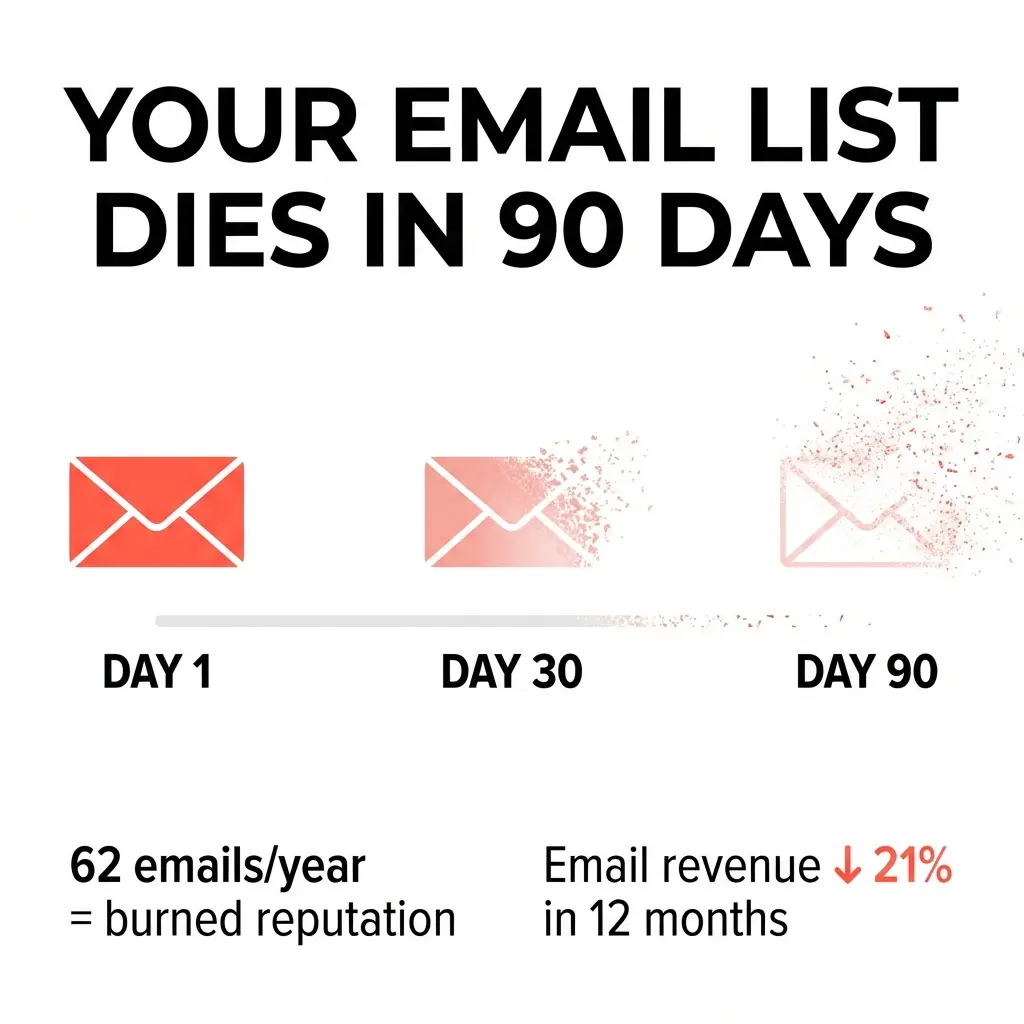
The data tells a story most organizations refuse to hear. Email revenue dropped 21% in just one year. Open rates are plummeting. And here's the part that should terrify you: your email addresses start burning after three months of regular campaigns.
Three months. That's all it takes.
By 2030, nonprofits will have abandoned email marketing. This isn't speculation. The collapse is already happening, and most organizations are too busy scheduling their next campaign to notice they're accelerating their own demise.
The Three-Month Death Spiral
Let me explain what "burning" actually means.
You launch an email campaign. Week one looks good. Week four, you're still hitting inboxes. But somewhere around month three, something shifts. Your emails stop landing in the primary inbox. They slide into promotions. Then spam.
Frequency kills your sender reputation faster than anything else.
Nonprofits sent an average of 62 emails per subscriber in 2024. That's more than one email per week. Email providers see this pattern and flag it as suspicious activity. You're essentially training Gmail, Yahoo, and Outlook to treat you like spam.
The math is brutal. High-reputation IPs have a spam rate of 4.1%. Low-reputation IPs? 34.6%. Once you cross that threshold, you can't come back.
And here's what most nonprofits miss: over 16% of your emails never reach donors at all. They vanish into spam folders or get blocked entirely. Microsoft's inbox placement rate sits at just 75.6%. Gmail's deliverability dropped almost 5% in 2024. Spam placement rates doubled from Q1 to Q4.
You're not just losing effectiveness. You're losing access.
The Metrics Tell the Real Story
Email revenue now accounts for only 11% of online revenue for nonprofits. Down from 14% the year before.
That's a 21% drop in twelve months.
Association email open rates fell to 35.6% in 2024, compared to 38.2% in 2023. Members are checking out. They're reporting spam complaints. The report is clear: people receive too many emails and they're done.
But revenue percentages and open rates only tell part of the story. The real shift is happening with younger donors.
Gen Z's likelihood to respond to text messages sits at 3.8 out of 5. Email? 3.6. Text messaging has a 99% open rate. Your email campaigns are lucky to hit 36%.
Over 70% of Gen Z and Millennials prefer communicating through messaging apps. They spend 6 hours and 5 minutes per day on their phones. And they're choosing WhatsApp, Viber, and Telegram because these platforms feel expressive, human, and real.
Email doesn't feel any of those things anymore.
Why Email Providers Are Turning Against You
Email providers have one job: protect their users from unwanted messages.
When you send 62 emails per year to the same person, you look like a spammer. When your open rates drop below 36%, the algorithm notices. When people start marking your messages as spam, you're finished.
Yahoo and Gmail expect spam complaint rates below 0.10%. Hit 0.30% and you're facing major deliverability issues. Most nonprofits have no idea what their complaint rate is until it's too late.
The system is designed to punish high-volume senders. And nonprofits, by nature, are high-volume senders. You have campaigns for year-end giving, monthly appeals, event invitations, impact updates, volunteer opportunities, and emergency fundraising.
Each email chips away at your sender reputation.
Privacy regulations are making this worse. Inbox providers are getting stricter about authentication, engagement metrics, and user preferences. The technical requirements keep increasing. The tolerance for promotional content keeps shrinking.
You're fighting a system that's actively working against you.
The Generational Divide Nobody Wants to Acknowledge
Your major donors still check email. They respond to appeals. They open your year-end campaigns.
But they're aging out.
The donors you need to cultivate over the next decade communicate differently. 13% of Gen Z has already given by text message. 75% of American Gen Z and Millennials prefer texting over face-to-face conversation.
Think about that. They'd rather text than talk in person. And you're trying to reach them through email.
The channel mismatch is killing your future pipeline.
Messaging apps offer something email can't: conversational engagement. When someone texts your organization, they expect a response. When they email you, they expect to wait days. The psychology is completely different.
Gen Z doesn't think of email as a communication tool. They think of it as where receipts and password resets go. Your carefully crafted appeal sits next to spam about extended car warranties.
What Replaces Email
Text messaging isn't the only answer, but it's part of the solution.
Multi-channel personalization is replacing one-size-fits-all blasts. You need to meet donors where they actually spend time. For some, that's Instagram. For others, it's WhatsApp. For your older donors, it might still be email.
But here's the shift: you can't build your entire strategy around a single channel anymore.
AI-driven engagement platforms are making personalized, multi-channel communication possible at scale. You can track donor preferences, engagement patterns, and communication history across platforms. You can automate responses while maintaining a human tone.
The organizations that survive the next five years will be the ones that stop thinking about "email strategy" and start thinking about "donor communication strategy."
Some nonprofits are already making this transition. They've reduced email frequency. They've invested in SMS platforms. They've built communities on messaging apps where donors can engage directly.
Their engagement rates are higher. Their donor retention is stronger. And they're not burning through email addresses every three months.
The Roadmap Forward
You can't flip a switch and abandon email tomorrow. Your current donors expect it. Your systems are built around it. Your team knows how to use it.
But you can start the transition now.
Audit your email frequency. If you're sending more than one message per week, you're damaging your sender reputation. Cut back. Be strategic about what actually needs to go out.
Segment aggressively. Stop sending the same message to everyone. Your 65-year-old monthly donor and your 22-year-old event volunteer need different communication strategies.
Test alternative channels. Start small with SMS for event reminders or urgent appeals. Build a presence on the messaging platforms your younger donors actually use.
Invest in multi-channel infrastructure now. The tools exist. The platforms are ready. The longer you wait, the harder the transition becomes.
Track engagement across all channels. Email open rates don't tell the full story anymore. You need to understand how people prefer to hear from you and respect those preferences.
The Investment You Can't Avoid
This transition requires money, time, and organizational commitment.
You need new platforms. New training. New strategies. And you need to make these investments while your email campaigns are still generating revenue.
That's the hardest part. You're being asked to fix something that isn't completely broken yet. But by the time email stops working entirely, it will be too late to build alternatives.
The organizations that thrive in 2030 will be the ones that started diversifying in 2025.
Email marketing isn't going to disappear overnight. But its effectiveness is declining fast, and the trend is clear. Younger donors don't use it. Email providers don't trust it. And your sender reputation degrades with every campaign you send.
The question isn't whether nonprofits will abandon email marketing. The question is whether you'll make the transition strategically or get forced out when your emails stop reaching inboxes.
Three months. That's how long it takes for your addresses to start burning.
How many campaigns have you sent this quarter?
Your nonprofit's email list is burning. You have about three months before it's toast.
I've been tracking nonprofit email campaigns, and the data is brutal:
→ Email revenue dropped 21% in one year
→ After 3 months of regular campaigns, your emails start going to spam
→ 16% of your messages never reach donors at all
→ Gen Z email open rates: 36%. Text message open rates: 99%.
Here's what most nonprofits miss: frequency kills your sender reputation faster than anything else. When you send 62 emails per year (the nonprofit average), email providers flag you as spam. You're literally training Gmail to block you.
By 2030, nonprofits will have abandoned email marketing.
The organizations that survive will be the ones diversifying NOW—into SMS, messaging apps, and multi-channel strategies that meet donors where they actually spend time.
Your 65-year-old donors still check email. Your 25-year-old future donors don't.
The question isn't whether email is dying. It's whether you'll transition strategically or get forced out when your campaigns stop reaching inboxes.
How many emails have you sent this quarter? 🔥
Related Blogs



Got Kicked Out of GroupMe? Look to Evant.
Michael PedoeemGot Kicked Out of GroupMe? The Best GroupMe SMS Alternative for Jewish Communities