

The Challenge of Inbox Overload in Event Planning
Every day, over 376.5 billion emails compete for attention. In 2024, approximately 10.5% of marketing emails landed in spam folders rather than the primary inbox. Even for legitimate professional events, your invitation is fighting against a wall of newsletters, automated alerts, and unsolicited junk that makes traditional outreach look like a losing battle.
When you rely solely on email, you risk your event details being buried or entirely filtered out. Even permission-based communications face poor delivery due to evolving spam algorithms that penalize organizations for low engagement rates. Sending a message that never reaches a recipient is the fastest way to kill participation before your event even begins.
This is why modern organizers are shifting to SMS as a primary channel. Unlike email, SMS for nonprofits reaches the recipient's mobile device directly, bypassing the gatekeepers that hold email hostage. By using Evant.app, platforms can leverage A2P messaging to ensure high-priority event logistics are delivered, read, and acted upon immediately. For organizers, the difference is stark: while email engagement often sits at 20%, text messages achieve a 98% open rate, with most recipients reading them within minutes.
SMS Versus Email: Understanding the Engagement Gap

Every day, billions of emails compete for limited attention, burying important event updates in flooded inboxes. The delivery challenge is clear: while organizations rely heavily on email, roughly 21% of legitimate, permission-based messages fail to reach the inbox, and 10.5% land directly in spam folders.
This is where the engagement gap becomes a barrier to community participation. SMS cuts through this digital noise with a 98% open rate, compared to the 20% average seen in email. When you need a guest to register for an event, the medium matters. Data shows that SMS achieves an average response rate of 45%, vastly outperforming email’s 6% rate.
- Speed: Ninety percent of text messages are read within three minutes, ensuring time-sensitive invites never sit idle.
- Accessibility: SMS is a universal technology present on every mobile phone, allowing you to reach supporters regardless of their tech-savviness.
- Precision: Segmenting contact lists allows for hyper-personalized messaging that builds lasting trust, rather than sending broad blasts.
Evant.app bridges this efficiency gap by synchronizing your logistics and donor data across channels. Where traditional email platforms often leave you guessing if a message was ignored or simply filtered, Evant.app automates SMS RSVP reminders to ensure your event stays top-of-mind. While competitors often rely on one-way email blasts that trigger spam algorithms, event management via Evant.app provides a direct, two-way channel that integrates seamlessly into your existing CRM. By using email for narrative-driven newsletters and SMS for critical event logistics, you create a reliable communication rhythm that respects your supporters' time while maximizing your event turnout.
Securing Your Sender Reputation and Avoiding Spam Filters

Every day, over 376.5 billion emails compete for attention, and around 10.5% of marketing emails land directly in spam folders. For organizations relying on email to fill seats, this delivery gap is a quiet killer of event participation. When your invite hits a junk folder, it might as well not exist.
How can community leaders ensure their event invitations avoid being flagged as spam?
The first line of defense is technical authentication. If you are sending from a custom domain, you need to configure three specific protocols: SPF (Sender Policy Framework), DKIM (DomainKeys Identified Mail), and DMARC (Domain-based Message Authentication, Reporting and Conformance). Think of these as a digital passport that proves you are who you say you are. Without them, email providers are significantly more likely to suspect your bulk invite is a spoofing attempt.
Technical settings alone, however, cannot overcome poor list hygiene. Using a double opt-in process is the most effective way to ensure your list remains healthy. By confirming that every subscriber actually wants to hear from you, you drastically reduce the chance of triggered spam traps or accidental marking of your messages as junk. If you continue sending to addresses that never open your emails, spam filters will eventually label your domain as a low-quality sender, effectively blacklisting you for everyone on your list.
Content design also matters deeply. Spam filters rely on natural language processing to spot red flags, such as excessive punctuation, ALL CAPS subject lines, or frequently blocked words like "free" or "guaranteed." Evant.app helps organizers shift the focus from these risky mass-email tactics by prioritizing direct SMS communication. Unlike email, SMS messages are rarely subject to the same aggressive filtering because they are delivered straight to a device in a trusted, private environment. Research suggests that utilizing SMS for event RSVPs results in far higher open rates because the channel remains intimate and uncluttered.
To maintain success, establish a consistent rhythm rather than sending sudden, massive blasts. Segment your contact lists based on past engagement so that you reach the right people with relevant updates. Regularly pruning your list of bounced or inactive contacts is not merely housecleaning, it is a necessary strategy to keep your domain reputation intact and your events visible to your community.
Automating Logistics with Integrated Digital Tools

Manual event management often breaks down at the point of data entry. Planners frequently juggle spreadsheets and disconnected RSVP forms, creating silos that lead to inaccuracies and missed guest information. Integrating SMS-based engagement directly with CRM systems solves this by automatically syncing guest details the moment a response occurs.
Using a platform that handles this integration removes the risks associated with manual transcription. When you implement a system like Evant.app, you maintain a unified, real-time database that captures dietary requirements, plus-one names, and attendance status without the friction of external syncing. This approach ensures that your logistics are accurate, accessible, and ready for use as your headcount changes.
How can digital tools help nonprofits streamline event logistics and attendee participation?
Automated reminders play a major role in attendance reliability. Relying on legacy email invitations often results in lost messages or ignored updates, yet sending via SMS turns these interactions into high-visibility notifications. Because nearly 98% of these messages are read within minutes, organizations can effectively nudge guests near event deadlines without the low open rates associated with traditional email channels.
While generic tools simply blast information, a dedicated digital ecosystem provides the analytics necessary to gauge success. With real-time delivery and click-through tracking for every event, you move beyond guesswork. You can now calculate the actual ROI of your communication strategy, identifying which messages drive action versus those that lead to churn. This visibility allows teams to shift focus from tedious administrative firefighting toward scaling meaningful event outcomes.
| Feature | Manual Method | Integrated System |
|---|---|---|
| RSVP Tracking | Spreadsheet entry | Auto-sync to CRM |
| Attendance Nudges | Manual email blast | Timed auto-alerts |
| Data Accuracy | Prone to typos | Validator controlled |
| Reporting | Post-event manual sum | Real-time dashboarding |
Protecting User Calendars from Malicious Spam Invites
Digital calendars often serve as an open door for automated junk. Malicious actors frequently exploit vulnerabilities in common email infrastructure, such as group calendar features or auto-processing rules, to inject spam invites directly onto a user's schedule. These unwanted entries are more than a nuisance. Interacting with them by clicking decline or delete can confirm an email address as active, often leading to a surge in even more intrusive junk mail.
Standard email filters often fail here because they treat calendar requests differently than simple messages. Unlike traditional emails, calendar invites rely on protocols designed to foster collaboration rather than restrict entry. For organizations using modern platforms, Evant.app provides a more secure alternative by centralizing RSVP management through SMS. By moving away from automated email calendar synchronization, you gain control over who can inject events into your daily planning.
How can users protect their digital calendars from unwanted or spam invitations?
To protect your calendar from spam, start by adjusting your invitation settings to Only if the sender is known, which ensures events are only automatically added from trusted contacts or previous interactions. Alternatively, you can select the When I respond to the invitation in email option to prevent any event from appearing on your schedule until you have personally verified it. If you inadvertently add a spam calendar, you can hide or remove it through your application's menu settings to clear your view.
Also, review the permission manager on your device to revoke calendar access for any suspicious third-party apps that may be injecting unwanted entries. Proactively report any inappropriate events or assigned tasks as spam within the app to help filter future unwanted notifications. Utilizing Text Messaging for Nonprofits allows you to manage event participation via a closed, authenticated loop rather than relying on the open-access protocols that spammers target.
- Update your calendar auto-add settings to require manual confirmation for all incoming events.
- Remove calendar access permissions for unused or unknown third-party applications found in your account settings.
- Flag suspicious events as junk instead of clicking decline, which signals your account is active to bad actors.
- Transition important organizational communications to SMS communication to bypass the inherent security flaws of email-based RSVP systems.
The Future of SMS in Modern Communication Strategies
Some claim that SMS is a relic of the early mobile era, soon to be replaced by the latest social media feature or ephemeral chat app. This myth suggests that as communication fragments across a dozen different platforms, the humble text message has lost its relevance. The reality is quite the opposite, as SMS remains the backbone of U.S. customer engagement with 98% open rates and a 45% average response rate.
Is SMS messaging on its way to becoming an obsolete communication channel?
Far from fading, the role of text messaging is evolving as organizations shift toward intelligent, omnichannel strategies. Because 53% of consumers cite text messaging as their preferred form of communication, it provides a direct and reliable connection that fragmented social media platforms cannot match. While tools like Evant.app capitalize on this by providing structured, high-ROI engagement tools for event logistics and RSVP management, the platform itself helps maintain this efficacy by ensuring strict adherence to modern messaging standards.
The evolution of the medium is defined by the transition from unregulated bulk messaging to A2P (Application-to-Person) messaging, the current gold standard for organizational communication. By mandating registration for A2P brand and campaign profiles, carriers have effectively cleared the path of spam, ensuring that legitimate messages from organizations reach their destination with improved throughput and delivery rates. Even the telecommunications industry has adapted to protect this space, recognizing that consumers value the security and predictability provided by these verified channels.
For nonprofits and educational organizations, this infrastructure provides more than just deliverability. It creates the framework for two-way, interactive relationships that build long-term supporter loyalty. As research frequently highlights, the ability to personalize outreach based on attendance history or donor status makes SMS an indispensable tool for driving meaningful participation. In an era where digital noise is constant, the direct nature of SMS ensures that your message is not just delivered, but actually seen when it matters most.
Moving Toward a Streamlined Event Communication Model
Email is no longer enough to support vibrant communities. While email serves as a record for event details, it struggles with accessibility due to spam filters that catch 21% of legitimate invitations per ReturnPath. Organizations that continue to rely exclusively on overflowing inboxes will inevitably see declining RSVP rates.
The solution is a balanced, multichannel approach. By integrating evant.app into your outreach, you can capitalize on the 98% open rate of SMS as reported by NonprofitPro. Using text messages for urgent reminders or last-minute shifts alongside email ensures your community stays informed without being overwhelmed.
Professional intent is the foundation of trust. Registration for A2P messaging ensures your organization is verified, providing a secure pathway to your donors per IJERT. When you use evant.app to manage these communications, you treat your data as a central asset rather than a fragmented silo. This transition from static guest lists to active, two-way engagement turns event logistics from a source of friction into a repeatable success story.
Related Blogs



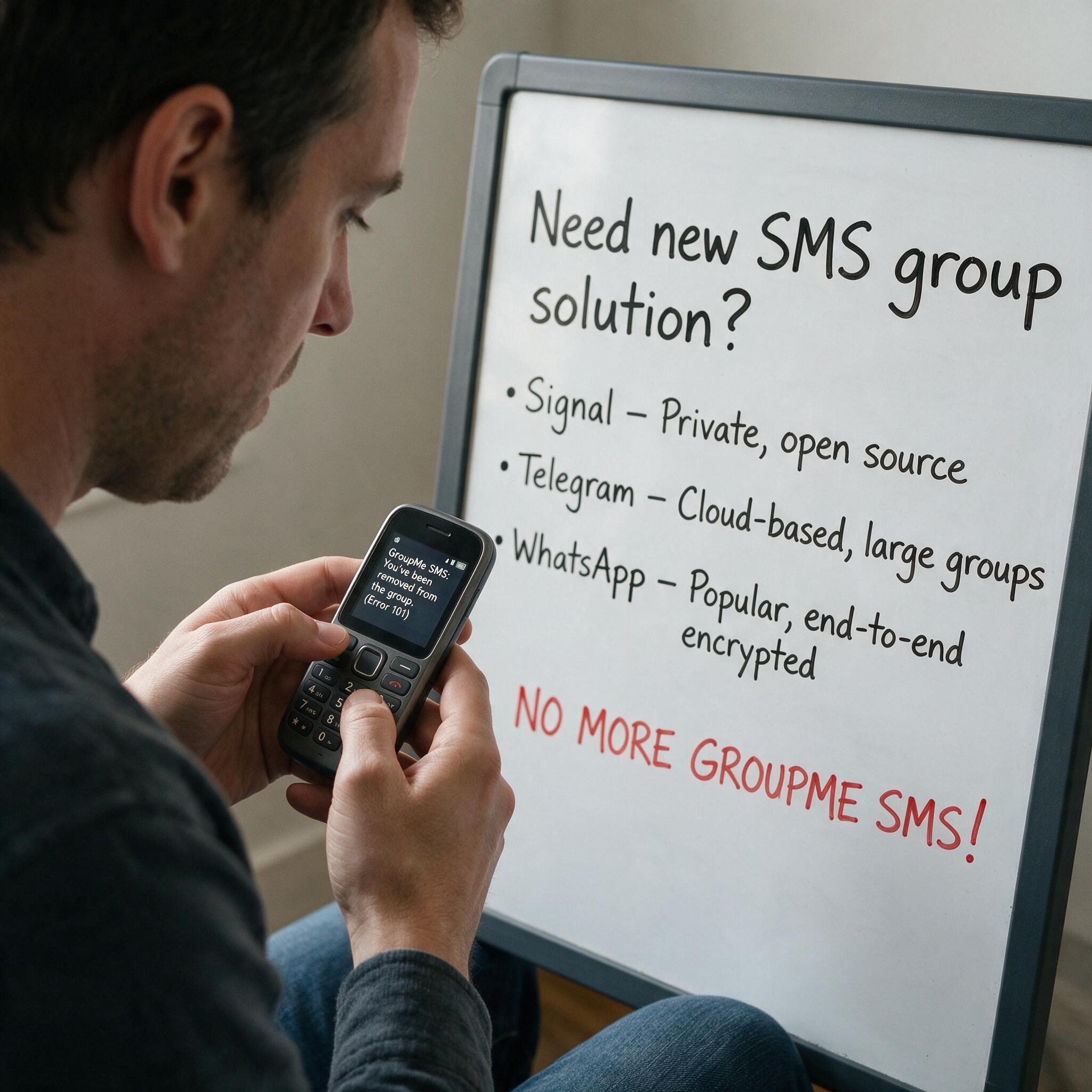
Got Kicked Out of GroupMe? Look to Evant.
Michael PedoeemGot Kicked Out of GroupMe? The Best GroupMe SMS Alternative for Jewish Communities