Church & Community SMS Glossary: 53 Texting Terms in Plain English (2026)

This is a church and community SMS glossary: the texting terms churches, shuls, schools and nonprofits actually run into, explained in plain English. A2P 10DLC, opt-in, keywords, segments, text-to-RSVP, voice broadcast and about 40 more. Each term has a one-line answer, and most link to the guide where I go deeper.
That's the short version. Bookmark it. Send it to the volunteer who just got handed "the texting thing."
I'm Mike, I built Evant. Updated November 2026. If you're looking for texting slang and emoji meanings, that's our other text messaging glossary. This one is for the people sending the texts.
Start here: the main guides by topic
If you want the long version of any section below, these are the hub pages. Each one links out to everything else on that topic.
- Churches: The complete guide to church text messaging
- Shuls and Jewish organizations: Best SMS platforms for Jewish organizations
- Nonprofits: Best texting platforms for nonprofits
- RSVPs and events: How to RSVP via text
- Rules and registration: A2P 10DLC registration guide
- Comparing tools: Best SMS platform for churches
- Giving and payments: Collect donations and RSVPs in one text
Rules, registration and compliance terms
The boring part. Also the part that gets your texts blocked if you skip it.
A2P (application-to-person)
Texts sent from software to people, like a church sending one message to 400 members. Almost all community texting is A2P, and carriers treat it differently from texting a friend. My A2P 10DLC registration guide covers what that means for you.
P2P (person-to-person)
A regular text between two people. Your phone, their phone. The moment you use a tool to send the same message to a list, you are not in P2P territory anymore.
10DLC
A standard 10-digit phone number used for A2P texting in the US. It looks like a normal local number, which is why members are comfortable replying to it.
The Campaign Registry (TCR)
The industry hub where 10DLC senders register their brand and their messaging campaign. The Campaign Registry is where your registration ends up, if you file it yourself or if your texting tool does it for you.
Brand registration
Telling the carriers who you are: legal name, EIN, address, website. For a church or nonprofit, use the exact legal name on your IRS paperwork or it can get rejected.
Campaign registration
Telling the carriers what you will text about and showing sample messages. "Weekly service reminders and event RSVPs" is a campaign. Vague answers slow approval down.
Carrier filtering
When a carrier quietly blocks or delays texts it thinks look like spam. Unregistered numbers, sketchy links and spammy wording all raise the odds. Here's how to keep your texts out of the spam pile.
Throughput
How many texts per second a number is allowed to send. It depends on your registration. For most churches it only matters if you send to thousands at once.
Opt-in
Permission to text someone. They gave you their number and agreed to hear from you. No opt-in, no texts. The CTIA messaging principles are what carriers hold everyone to.
Double opt-in
Someone signs up, then gets a text asking them to confirm by replying YES. Extra step, cleaner list.
Opt-out (STOP)
When someone replies STOP, they are off the list. Right away. Every time. Your tool should handle this automatically.
HELP reply
People can text HELP and should get back who you are and how to reach you. Carriers expect it.
TCPA
The Telephone Consumer Protection Act, the federal law behind consent rules for calls and texts. The FCC has a plain overview of its telemarketing and robocall rules. I'm not a lawyer. If you're unsure, ask one.
Phone numbers and how texts get sent
Dedicated number
A phone number that belongs to your organization only. Members save it as "Church" or "Shul" and know who's texting. Evant gives every account a dedicated 10-digit number.
Shared number
One number used by many organizations. Cheaper for the provider. Confusing for your members, and replies get messy.
Toll-free number
An 800, 888 or similar number that can send texts after it goes through toll-free verification. Works fine, but it looks less local than a 10DLC number.
Short code
A 5 or 6 digit number, like the ones big brands use for contests. Built for huge volume. Usually overkill for a congregation.
Landline texting
Turning an existing office landline into a number that can send and receive texts. Handy if your church number is printed on 30 years of bulletins.
Mass texting (broadcast)
One message to many people, each getting it as a private text. Not a group chat. Nobody sees anyone else's number or reply. Here's what church texting is in more detail.
Group text
A shared thread where everyone sees every reply. Fine for a small committee. Chaos for a congregation. If you're using GroupMe for this, see my GroupMe alternatives.
Two-way texting
Members can reply and you can answer, one on one. This is the difference between an announcement and a relationship. More on ongoing text conversations.
Message basics: SMS, MMS, segments and credits
SMS
A plain text message. Works on every phone, including flip phones and kosher phones.
MMS
A text with a picture, video or long content. Looks nice. Costs more on most platforms, and some basic phones won't show it.
Segment
Texts are billed in chunks called segments. One segment holds 160 standard characters. Go over and the message splits into segments of 153 characters each, so a 200-character text counts as two.
GSM-7
The standard character set: letters, numbers, basic punctuation. Stick to it and you get the full 160 characters per segment.
Unicode (UCS-2)
What your text switches to when it includes an emoji or certain special characters. One segment drops to 70 characters, and 67 when split. One smiley can double the cost of a text.
Credits
How many tools bill you: one credit per segment per person, more for pictures. It's why "1,000 credits" disappears fast. I did the math in Clearstream pricing 2026 and Text In Church pricing 2026.
Merge field
A placeholder like [First Name] that fills in for each person. "Hi Sarah" beats "Hi everyone." Tips on personalizing messages at scale.
Link shortener
Turns a long URL into a short one. Public shared shorteners can trigger carrier filters, so use your own domain or your texting tool's branded links. Email has its own spam problem, by the way.
Features you'll hear about
Keyword
A word people text in to trigger something. "Text SERVE to 555-0100" signs up volunteers. Keywords also work inside replies, like YES, HELP or PLAN. See how churches use them to get more volunteer replies.
Text-to-join
A keyword that adds someone to your list. Put it on a slide, a bulletin or a flyer.
Click-to-text link
A link or QR code that opens someone's texting app with your number and keyword already typed in. They just hit send. Make one with our free SMS link generator.
Text-to-RSVP
People reply YES (or a number, like YES 3) and they're counted. No form. No link. No login. Start with text-to-RSVP for churches or the complete guide to RSVP by text for faith communities. And yes, it's OK to RSVP by text.
Text-to-give
Giving that starts with a text: a keyword or a link to a donation page. In Evant every customer gets a customizable Stripe donation page at no extra charge. Send a text. They tap the link. They give. Done. Also see collecting RSVP fees by text and how to ask for payment through text.
Scheduled message
Written now, sent later. The way to send a Friday morning reminder without touching your phone on Shabbat, or a countdown text the day before an event.
Text reminder
A short nudge before something happens. The simplest way to cut no-shows.
Segmentation (lists and tags)
Splitting your list so each group gets only what applies to them. Youth parents, choir, donors, volunteers. More on segmenting your audience.
Text poll
A question with reply options: "Reply 1 for 9am, 2 for 11am." Here's how text polls can drive attendance.
Event check-in
Marking who actually showed up, at the door. Often paired with a QR code. See RSVP plus QR check-ins.
Voice broadcast
A recorded phone call sent to a list. For members who don't text, like older folks on landlines. Evant includes voice calls on every plan at 1.5¢ a minute.
IVR (phone menu)
"Press 1 for service times." A menu callers move through with their keypad. Useful when your office line rings more than you can answer.
CRM / ChMS integration
Connecting your texting tool to the database where your members live, so you're not keeping two lists. Shuls, see this guide to synagogue management software.
Measuring what worked
Delivery rate
The share of texts that actually reached a phone. A sudden drop usually means a registration or filtering problem, not a bad message.
Response rate
The share of people who replied. For an RSVP text this is the number that matters.
Click rate
The share of people who tapped your link. Only meaningful if the text had one link and one ask.
SMS analytics
All of the above, in one place, over time. Here's how analytics improve your next event and how nonprofits use them.
Words that are specific to communities
Kosher phone
A phone with internet blocked or limited, common in Orthodox communities. Some can text, some are talk-only. Here's kosher phone texting for shuls.
Basic or flip phone
No apps, maybe no data. Plain SMS still lands. This is why "download our app" leaves people out. Evant texts work on every phone, and members don't download anything.
Church texting
A church using texts for reminders, RSVPs, volunteers, care and giving. If you're picking a tool, start with the best church texting services or the head-to-heads: Evant vs Text In Church, Evant vs Clearstream, Evant vs Flocknote.
Congregation texting
Same idea, any faith. A shul, a parish, a mosque, a Chabad house. See engaging your congregation by text, my take on the best communication tool for Chabad houses and the best texting app for Catholic parishes.
School texting
Schools texting parents about pickup changes, events and closings. More in texting services for schools.
Campus ministry texting
Student groups texting students, who mostly ignore email. Here's why campus ministries are switching to SMS.
Holiday text calendar
Planning a season of texts ahead of time with real dates. See my Christmas church text templates and Chanukah texts for synagogues.
FAQ
What does A2P 10DLC mean?
A2P means application-to-person, texts sent from software to many people. 10DLC is a standard 10-digit local number. Together they describe how most churches and nonprofits text members in the US, and those numbers must be registered with the carriers.
How many characters is one text message?
One SMS segment holds 160 standard characters. Longer texts split into segments of 153 characters. If you add an emoji, the limit drops to 70 characters per segment.
What is the difference between a group text and mass texting?
In a group text everyone sees every reply. In mass texting each person gets a private copy and replies only to you.
What is text-to-RSVP?
A way to collect RSVPs by text. People reply YES, or YES and a number, and the reply is counted. No form or link needed.
So which of these terms actually matter first?
Five. Opt-in, A2P 10DLC, segment, two-way texting and text-to-RSVP. Get those right and the rest is details. Everything else on this page you can look up when it comes up.
And if you'd rather not learn half of them, Evant handles your A2P 10DLC registration and gives you a dedicated number. Plans start at $20 a month. It's simple enough that a 5 year old could use it. I know because I am very simple myself.
👉 Start your free trial. No credit card.
Related Blogs
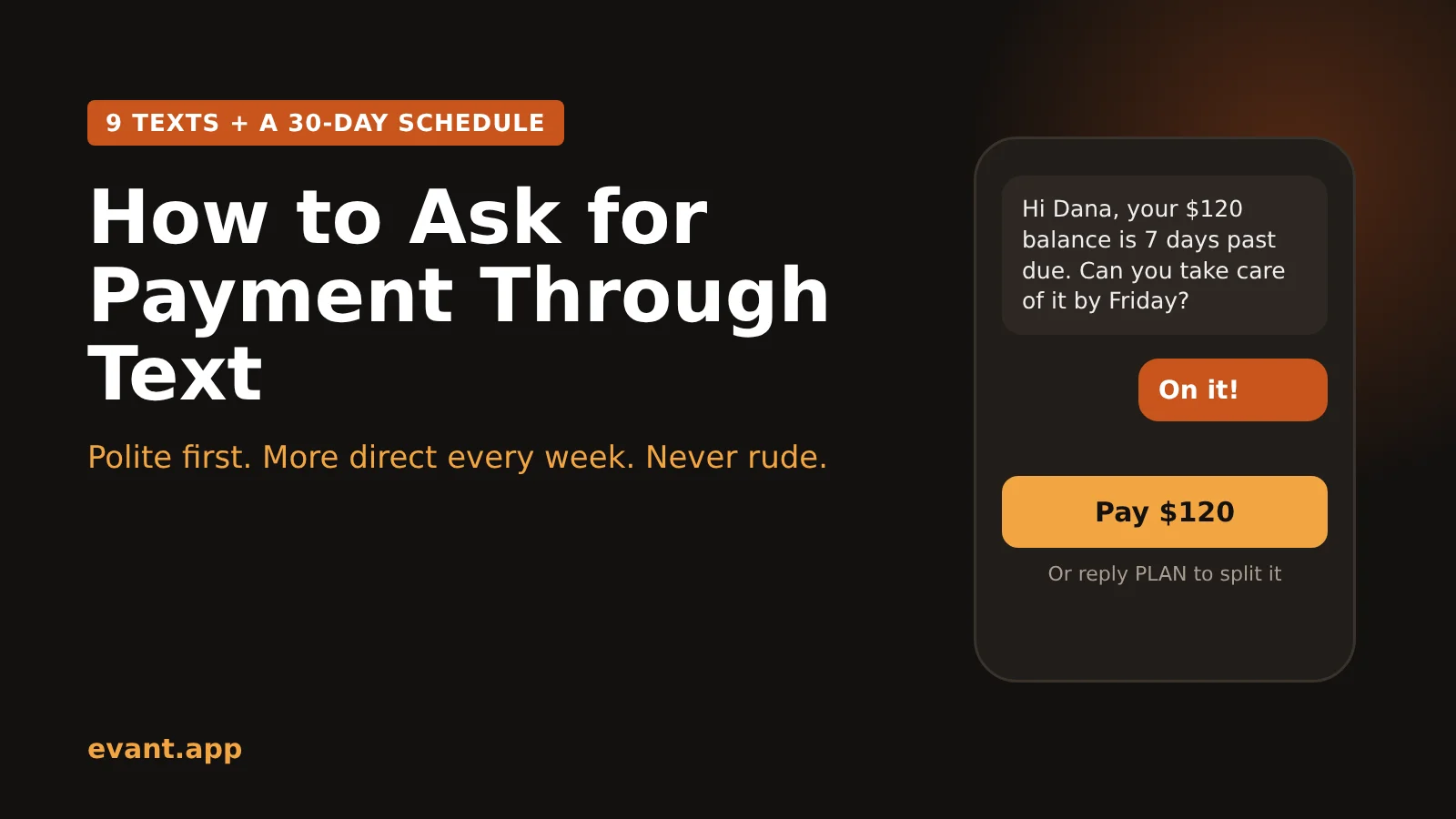

How to Ask for Payment Through Text: 9 Texts and a 30-Day Reminder Schedule
Michael PedoeemA polite-to-firm reminder schedule, nine copy-ready payment texts, when to call or email, and what to do with invoices that stay unpaid.

The Best Communication Tool for Chabad Houses (and Why So Many Already Use Evant)
Michael PedoeemWhy many Chabad houses run their texts and RSVPs on Evant, and where Chabad on Campus RSVP, TextIt and WhatsApp still win.
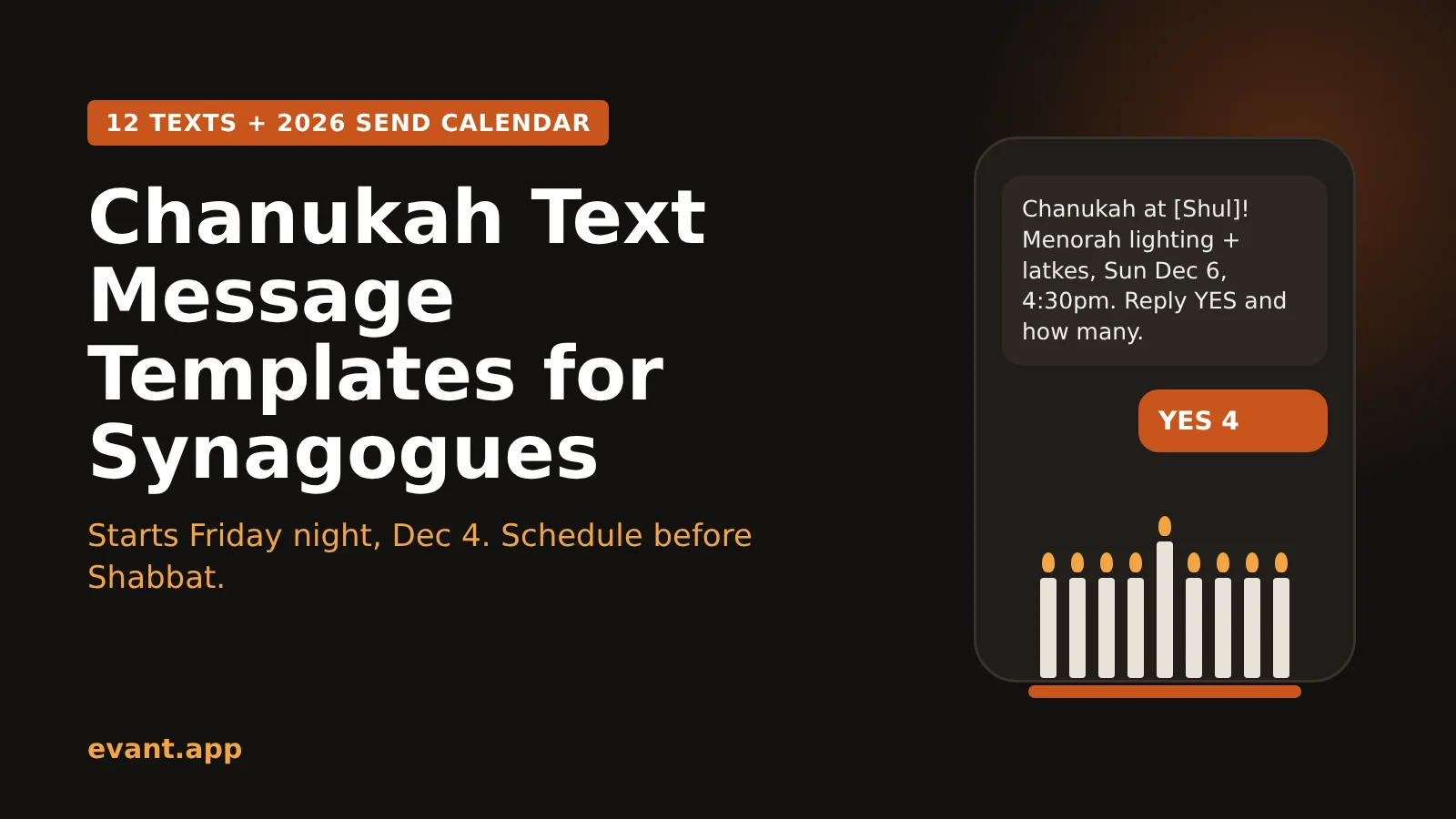
Chanukah Text Message Templates for Synagogues: 12 Texts for 2026
Michael Pedoeem12 copy-ready Chanukah texts for shuls, each under 160 characters, with 2026 send dates that work around both Friday-night candles.





Get the Evant app



