How to Ask for Payment Through Text: 9 Texts and a 30-Day Reminder Schedule
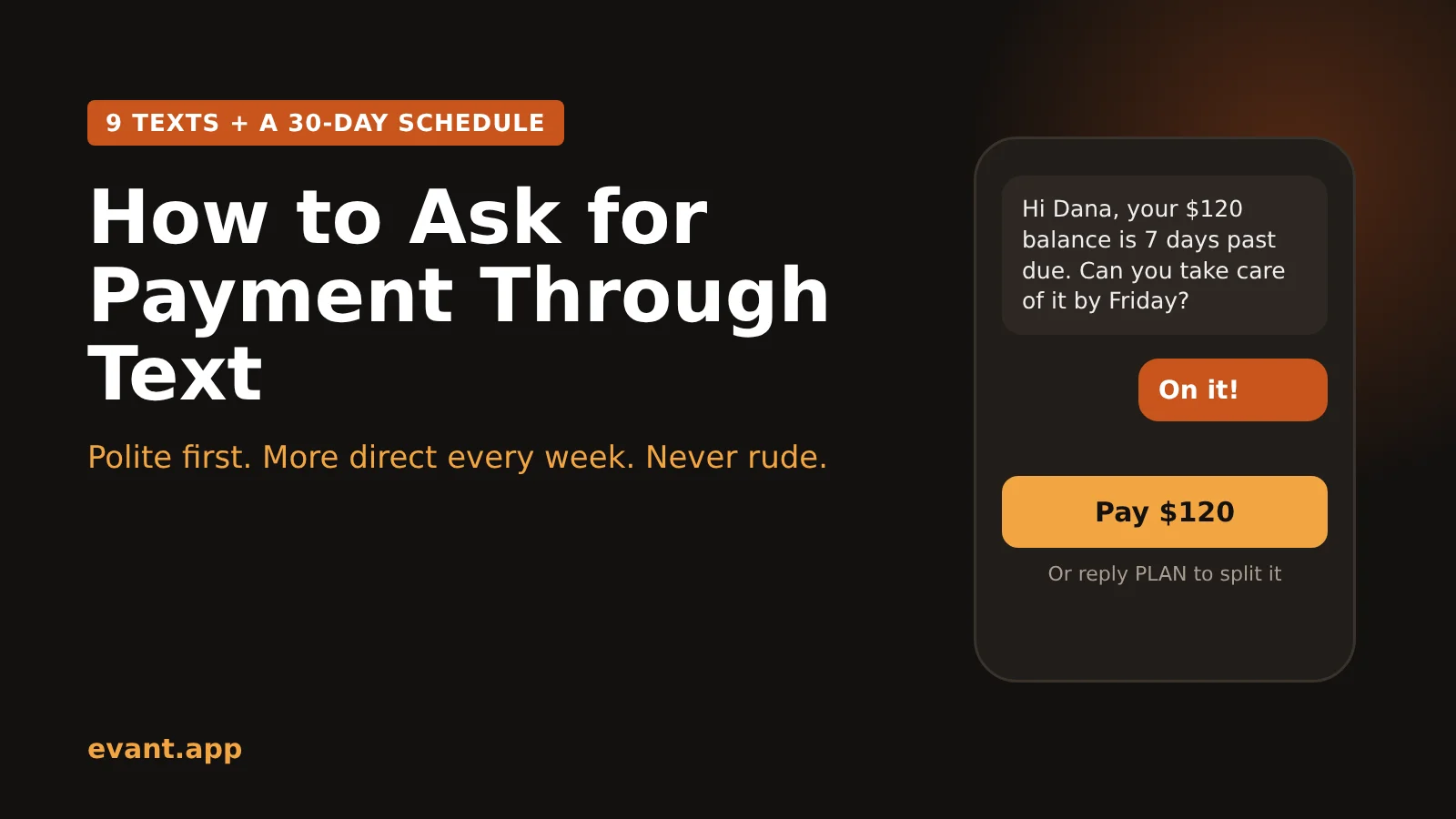
Here's how to ask for payment through text: send a friendly reminder before the due date, a clear one on the day, and then a short series that gets a little more direct each week. Every text has the amount, the date and a payment link. Never a threat. If texts don't work, add a phone call and an email, and for business customers, loop in their manager. After about 30 days, the invoice leaves the reminder flow and goes into a separate system for unpaid accounts.
That's the short version. Below is the exact schedule I'd use, nine texts you can copy, and what to do when someone still doesn't pay.
I'm Mike, I run Evant. Most of our customers are churches, shuls, schools and nonprofits, so they're chasing dues, tuition, pledges and event fees, not huge invoices. The method is the same either way.
Why most payment reminder advice falls short
I read the pages that show up first for this question. They're fine. They give you two or three polite templates and tell you to "follow up within a reasonable time frame."
Here's my issue with that. Polite once is easy. The hard part is reminder number four, when you're annoyed and they're ignoring you. None of them tell you how the tone should change. Or when to pick up the phone. Or what happens on day 31.
So here's my rule. Start polite. Get a little more straightforward and upfront as the days go by. Never threaten, never get nasty. But get more pushy, in a polite way.
The reminder schedule: polite first, then more direct
Seven touches over five weeks. Two of them happen before anyone is late. That matters. Plenty of late payments aren't people refusing. They forgot.
9 texts for asking for payment, from polite to pushy
Copy, swap the brackets, send. Every one is under 160 characters, so it stays a single text.
Before it's late
1. 3 days before: "Hi [Name], quick heads-up: your $[amount] payment to [Org] is due Friday. Pay here: [link]. Thanks!"
2. Due date: "Hi [Name], your $[amount] payment to [Org] is due today. Pay in a minute here: [link]. Questions? Just reply."
A little late
3. 3 days late: "Hi [Name], looks like your $[amount] payment from [date] slipped through. Easy to miss! Here's the link: [link]"
4. 7 days late: "Hi [Name], your $[amount] balance is now 7 days past due. Can you take care of it by Friday? [link] Reply if something's off."
See the shift? Text 3 gives them an out. Text 4 says "past due" and asks for a date. Still friendly. Less wiggle room.
Getting upfront
5. 14 days late: "Hi [Name], your $[amount] balance is 2 weeks overdue. I'll call you tomorrow to sort it out, or pay here first: [link]"
6. Payment plan offer: "Hi [Name], if paying $[amount] at once is tough right now, reply PLAN and we'll split it up. No awkwardness. We just want it settled."
Text 6 is the one people skip, and it's the one I'd send most. For a family paying tuition or a member behind on dues, embarrassment can be the real reason they've gone quiet.
Firm
7. 21 days late: "Hi [Name], we still haven't received the $[amount] for [invoice #], now 3 weeks late. Can we close this out this week? Happy to hop on a call."
8. To their manager (business accounts only): "Hi [Manager], this is [You] from [Org]. Invoice [#] for $[amount] is 3 weeks past due. Could you help us get it to the right person?"
9. Final notice: "Hi [Name], this is our final reminder for the $[amount] past-due balance. Please pay by [date] or call me to set up a plan: [link]"
What you never put in a payment text
- Threats. No "or else," no hints about consequences you haven't decided on.
- Shame. Nothing that would be embarrassing if someone else saw their phone.
- ALL CAPS or a wall of exclamation points. It reads as yelling. Because it is.
- Five links. One payment link. If the link breaks, the text failed.
Pushy in a polite way means the facts get sharper while the manners stay the same. Amount. Date. Link. A clear next step.
Should you contact a customer's manager or CEO?
If the customer is a business, yes. A sponsor's marketing team, a vendor, a company that booked your hall. When an invoice sits for three weeks, it's often stuck on someone's desk. A polite note to the manager or owner can unstick it. Text 8 above is how I'd word it. Factual, no blame.
If the customer is a person, no. Don't contact someone's boss about their personal bill. Federal rules for debt collectors bar them from discussing a consumer's debt with third parties like an employer (CFPB Regulation F, 12 CFR 1006.6). Even if those rules don't technically cover you, it's a fast way to lose a member forever. I'm not a lawyer, so if you're unsure, ask one.
Automate it, then add calls and email
Nobody remembers to send reminder number five on a Tuesday. So don't rely on remembering. Schedule the whole series the day you send the invoice.
Texting is the first channel because people actually read texts. But it shouldn't be the only one:
- Email is where the invoice PDF and the paper trail live. Send one with text 4.
- A phone call at two weeks is harder to ignore than any text. For older members, or the ones on kosher phones that can't open links, a call may be the only thing that works.
In Evant, that looks like this. Schedule texts 1 through 5 ahead of time and target them to the people who still owe. Two-way texting means "can I pay Monday?" lands in your inbox and you can answer it. A keyword trigger catches PLAN replies. Email is free, and voice calls are on every plan at 1.5¢ a minute. One number for all of it, so they know it's you.
If you're collecting donations or pledges, every Evant customer also gets a customizable Stripe donation page at no extra charge. Send a text. They tap the link. They give. Done. I wrote more on collecting donations and RSVPs in one text and putting payments into your RSVP flow.
Day 31: have a separate system for unpaid invoices
This is the step almost everyone skips. After the final notice, stop sending the same reminders. More texts won't help, and they start to feel like harassment.
Move the account into a different process instead. Decide it once, write it down, and apply it the same way to everybody:
- Pause what they're paying for. Next event registration, the service, the booking. Whatever your terms say.
- Offer a written payment plan. Smaller amounts, set dates, scheduled reminders for each one.
- Apply late fees only if your terms already say so. Not as a surprise.
- Decide your last step in advance. A collections agency, small claims, or writing it off. For a shul or a school, sometimes the right answer is a quiet conversation with the rabbi or principal.
The point is that it's a system, not a mood. Nobody gets chased harder because you had a bad day.
A few rules before you text anyone about money
- Only text people who gave you their number and agreed to hear from you. Honor STOP right away. The carriers hold everyone to the CTIA messaging principles.
- Send during business hours. A payment text at 11pm feels like a threat even when it isn't.
- Register your number. Business texting in the US needs A2P 10DLC registration or carriers start filtering you. Evant handles it, and here's my A2P 10DLC guide if you're doing it yourself.
If you want more templates, SimpleTexting's post has three good ones for before the due date, the due date and overdue. Use them. Just know they stop at "overdue."
FAQ
How do you politely ask for payment by text?
Say who you are, the amount, the due date and include one payment link. Keep it under 160 characters and send the first one a few days before the due date, so it reads as a heads-up instead of a complaint.
How many payment reminders should you send?
About seven over five weeks: before the due date, on it, then at 3, 7, 14, 21 and 30 days late. Add an email at 7 days and a phone call at 14.
What do you say when a customer won't pay?
Get more direct without getting rude. State how late it is, ask for a specific date, offer a payment plan and tell them you'll call. After a final notice, move the account to your unpaid-invoice process.
Is it OK to contact a customer's boss about an unpaid invoice?
For a business customer, a polite note to their manager or owner is normal. For an individual's personal bill, don't. Debt collectors are barred from discussing a consumer's debt with their employer under CFPB Regulation F.
So what's the best way to ask for payment through text?
Polite before it's late. Clear on the day. A little more direct every week after. A call at two weeks, the manager at three for business accounts, and a real system at thirty days. Most people just need the reminder. The schedule handles the rest.
Set it up once in Evant and stop remembering. It's simple enough that a 5 year old could use it. I know because I am very simple myself.
👉 Start your free trial. No credit card.
Related Blogs


Church & Community SMS Glossary: 53 Texting Terms in Plain English (2026)
Michael PedoeemA2P 10DLC, opt-in, segments, keywords, text-to-RSVP and 48 more texting terms for churches, shuls, schools and nonprofits, explained plainly.

The Best Communication Tool for Chabad Houses (and Why So Many Already Use Evant)
Michael PedoeemWhy many Chabad houses run their texts and RSVPs on Evant, and where Chabad on Campus RSVP, TextIt and WhatsApp still win.
Chanukah Text Message Templates for Synagogues: 12 Texts for 2026
Michael Pedoeem12 copy-ready Chanukah texts for shuls, each under 160 characters, with 2026 send dates that work around both Friday-night candles.





Get the Evant app



