
The Staffing Ceiling in Community Events
A nonprofit runs a successful community event. Attendance grows. The team adds a second event, then a third. Suddenly, someone is sending manual reminders at midnight, another person is juggling spreadsheets, and the volunteer coordinator is burned out. The organization has hit a wall: growth now demands more people, but the budget doesn't stretch to hire them.
This pattern is common. The Three Case Studies Applying the Scaling Principles paper documents how a single-location community of practice grew from 30 members to 300 across seven locations without new hires — by shifting from staff-led operations to a hub-and-spoke model with volunteer hosts. The question is not whether scaling without people is possible, but which systems make it repeatable.
Three levers break the staffing ceiling: SMS automation that handles reminders and follow-ups without adding calls or emails; a centralized platform that replaces spreadsheets and inboxes; and volunteer systems that turn one-time helpers into consistent force multipliers. This article explores each lever through real-world case studies and practical strategies for organizations that want to grow their community impact without growing their payroll.
Why Scaling Without Staff Is the New Imperative

The U.S. Bureau of Labor Statistics notes that event planners already work long, irregular hours to meet deadlines. Adding more events to an already packed schedule is not a viable path to growth.
Sustainable scaling decouples growth from any single person's hours. Instead of working more, organizations build systems, leverage technology, and distribute roles. This shifts the focus from personal effort to repeatable processes.
A common mistake is scaling chaos — adding events before systematizing the workflow. Growth applied to disorganized processes produces more confusion, not more impact. The fix is to systematize first, then scale.
Nonprofits can avoid this trap by automating repetitive tasks like SMS reminders, check-ins, and volunteer follow-ups. A platform like Evant turns event logistics into a streamlined process that any team member can run without prior context.
Empowering volunteers with self-service tools for scheduling and communication lets them take ownership of smaller events. This allows a small staff to oversee more activity without growing the team. Integrating CRM and analytics helps staff act on real-time data instead of guesswork.
Three-Stage Model: Before, During, After
Scaling community events requires more than just adding attendees. It demands a repeatable framework that reduces staff burden at every turn. A practical model divides each activity into three stages: before, during, and after.
Before an event, members need to see clear themes and opportunities. Use automated channels like SMS to surface event highlights, speaker previews, and registration links. This ensures consistent communication without requiring manual work every time.
During the event, create entry points such as community hosts or ambassadors who welcome attendees and facilitate introductions. These roles can be supported by lightweight prompts sent via SMS, guiding ambassadors in real time without extra staff oversight.
After the event, provide a tangible next step that turns attendance into repeat participation. A structured follow-up sequence — automated within a platform like Evant — sends thank-you messages, links to discussion groups, and invitations to contribute. This prevents engagement from fading.
This model maps directly to a participation progression pathway: Attend → Connect → Participate → Return → Contribute → Host → Lead. Each stage signals readiness for the next. Automating the administrative layers — reminders, follow-ups, ambassador prompts — frees staff to focus on the human connections that drive progression forward.
Case Study: Hub-and-Spoke Model in Action
A community of practice scaled from 30–80 members in one location to 300–500 members across seven locations — without adding a single staff member. The solution was a hub-and-spoke model, where a central organizer coordinates trained local volunteer leaders who handle logistics, communication, and facilitation in their own groups.
Two principles drove the transformation. First, "reach before teach" — the team prioritized expanding the community's reach over delivering deep content, welcoming more members into the fold. Second, "share leadership" — facilitation and organizational roles were distributed among members, not hoarded by the central team.
The results were measurable. Member retention increased by 50% after the model was implemented, because local leaders created stronger, more personal connections within their groups. This case shows that scaling community events without more staff is achievable by systematically identifying and empowering volunteer leaders, standardizing resources like facilitator guides and event templates, and using lightweight coordination tools to maintain alignment.
Evant’s SMS automation platform complements this model perfectly: the same central organizer can send reminders, prompts, and follow-ups to volunteer leaders across all seven locations with a single broadcast, freeing them to focus on the human connections that drive retention.
Leveraging SMS for Staff-Light Event Logistics
SMS has a 99% open rate, with messages read almost immediately after delivery. For community events, this means critical updates — a room change, a weather cancellation, a last-minute schedule tweak — reach every attendant without staff needing to make phone calls or stand at a help desk answering the same question fifty times. SMS reminders alone can reduce no-show rates by up to 38%, directly cutting the wasted capacity that frustrates organizers and funders alike.
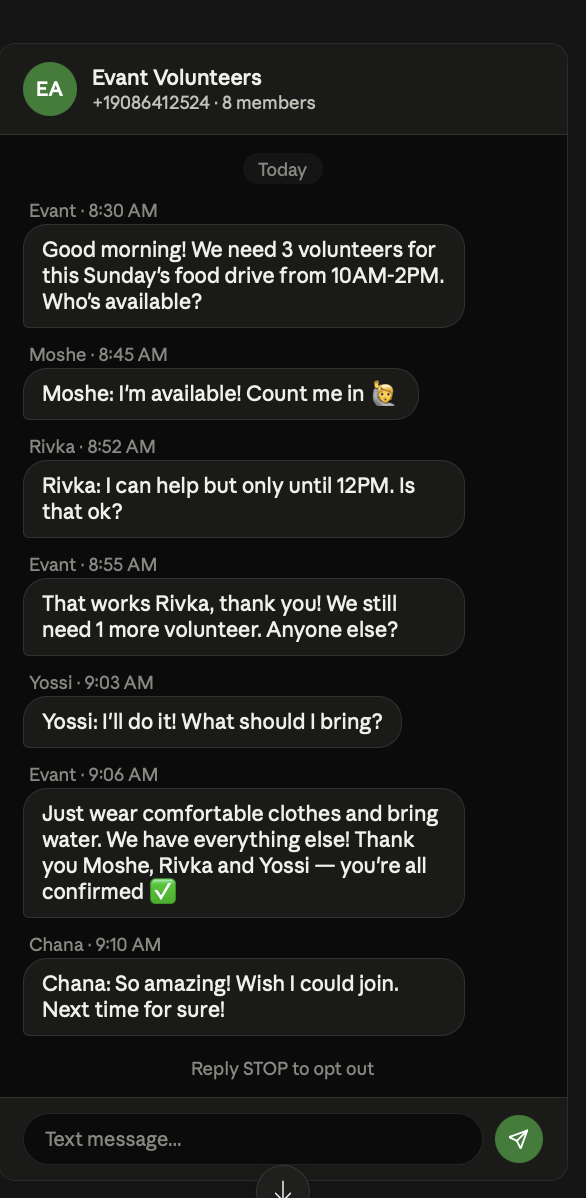
Automated SMS sequences handle the bulk of communication logistics — event reminders, schedule updates, post-event follow-up surveys — without adding staff hours. One mass text replaces countless phone calls, paper handouts, and printed programs. Staff who would have spent the day managing logistics can instead focus on high-touch tasks: welcoming first-time attendees, supporting volunteers, and handling exceptions that require a human touch.
Proven Success at Scale
Morning Brew coordinated a 500-person summit using SMS for real-time communication, contests, and surveys, all managed with a minimal staff team. Talk Media achieved over 95% virtual event participation using SMS to build excitement, facilitate personalized interaction, and drive attendance — again with a lean crew. These cases show that the channel itself can absorb the operational load that would otherwise require extra hires.
An SMS-first logistics layer works even better when paired with a platform that keeps attendee data, RSVPs, and message history in one place rather than scattered across spreadsheets and email inboxes. By combining automated SMS workflows with centralized event data, organizations can run larger, more complex events without proportionally larger teams. The result: staff-light operations that still deliver reliable, responsive communication.
Technology Stack That Scales Without Headcount
The right technology stack lets a small team act like a large one. A well-configured CRM turns a single inquiry into an automated response, follow-up sequence, payment reminder, and review request — all without manual effort. Tools like HoneyBook and Dubsado handle this, but they solve only one piece of the puzzle.
The missing piece is venue and event management software that serves as a single source of truth for the entire operations team. Instead of hunting through email threads for the catering contact or the AV setup time, catering staff, venue managers, and event coordinators all work from a live, unified schedule. This coordination layer is where most nonprofit teams waste hours.
Dedicated community engagement platforms like Tradewing, Breezio, and Hivebrite centralize event management, discussion spaces, and member directories into one place. They reduce the reliance on scattered spreadsheets and inboxes. However, many of these platforms treat SMS as an afterthought. That is where Evant differs: it puts SMS RSVPs, check-ins, two-way messaging, and automated reminder sequences at the core of the stack, designed specifically for the repetitive admin — reminders, event setup, ambassador prompts, and follow-up invitations — that eats up staff time.
The goal of automation is to free the team for human support, not just to send more messages. When the platform handles repetitive logistics, staff can focus on welcoming first-time attendees, connecting people around shared topics, and ensuring volunteers feel supported. That shift from admin manager to community builder is what makes scaling without headcount possible.
Empowering Volunteers as Force Multipliers
Ambassadors and volunteers are not a loose group to be managed ad-hoc. They are a system responsible for clear workflows: welcoming first-time attendees, introducing people around shared interests, and noting where members need follow-up. When every ambassador follows the same playbook, the quality of participant experience becomes consistent and repeatable.
A peer-learning network demonstrated this by scaling from 5 to 25 chapters under minimal central oversight. The model relied on trained facilitators, standardized event templates and facilitation guides, and a lightweight coordination tool (group messaging) to keep chapters aligned — all without adding paid staff.
A single, clear view of everything happening — meetups, ambassador roles, discussions — reduces friction for members who want to get involved. Evant.app provides that centralized view alongside automated SMS RSVP and check-in, so ambassadors can focus on welcoming rather than on spreadsheets and manual coordination.
To widen participation beyond the same active few, offer lightweight ways to contribute: suggesting a topic, welcoming a newcomer, or sharing a resource. These micro-contributions build confidence and create a pipeline from attendee to host to leader. The system should capture those signals and match them to the right next step.
From Spreadsheets to Centralized Workflow
A common scaling problem emerges when staff rely on scattered spreadsheets, clogged inboxes, and their own memory to manage events. This approach almost always leads to inconsistent follow-up, duplicate effort, and missed tasks as the number of activities grows. The solution is a centralized workflow managed through a single platform.
Centralized workflow management transforms chaos into order by providing one place to manage schedules, communications, and task lists. When every team member works from the same source of truth, the confusion of hunting through emails or papers disappears. Teams using a unified platform can coordinate logistics, share real-time updates, and ensure nothing slips through the cracks. This is where a tool like evant.app provides a concrete advantage over ad-hoc spreadsheets.
Centralized task lists and clear timelines show each person what to do and when, reducing time spent waiting for instructions or duplicating someone else's work. Mobile work order systems take this further by allowing team members to receive updates and instructions on their phones in real time. A volunteer coordinator can text a room change to the entire setup crew, or a staff lead can reassign a task instantly--all without a single phone call or paper chase.
Transitioning from fragmented tools to a centralized workflow does require an upfront investment of time to set up the new system. But the payoff is immediate: fewer missed follow-ups, faster response to changes, and a team that can handle more events without burning out. For organizations serious about scaling without adding headcount, this shift is not optional.
Measuring What Matters: Participation Progression
Relying on member count or event attendance to measure growth hides a dangerous truth: you might be adding attendees without building capacity. If administrative effort per activity rises every time the community expands, the scaling model is broken, and burnout is inevitable.
Better scaling metrics track behavior, not size. Instead of asking "How many people came?", ask "How many first-time attendees became repeat participants?" and "How many members took a small step, like suggesting a topic or welcoming a newcomer?" Internal cross-link to coverage of participation progression in the customer’s own article.
These signals of contribution diversity (volunteer sign-ups, topic suggestions, hosting a session) reveal whether the community is developing future leaders or simply cycling the same active few. Evant’s analytics can track this progression from attendee to contributor to host, giving staff a clear view of where the growth path is working and where members stall, without needing to dig through spreadsheets.
First-to-Second Step Conversion. Measures the percentage of members who come to one event and then take a second action (attend another event, join a subgroup, or sign up to volunteer). A low number here points to a weak post-event follow-up or unclear next steps. Admin Effort Per Activity. Tracks the staff hours or manual tasks required to run each event. If this number stays flat or drops as events multiply, the scaling model is sustainable. If it increases, the team is absorbing growth with human effort rather than systems.
Real Results: Cost and Time Savings in Practice
TEDxMileHigh replaced printed programs with a mobile app, saving $7,000 on printing costs and generating over 16,000 app sessions. This shift cut a major budget line item while giving attendees a more engaging digital experience.
Indiana Tech used an event app for their admitted students day and doubled student yield while giving staff 375 hours back. The University of Manchester went even further, moving from 40,000 printed programs to zero, eliminating the cost and waste of paper entirely.
Beyond printing savings, a nonprofit organization transformed its marketing approach by moving from reactive, manual efforts to a digital-first strategy. They optimized their website, built email campaigns, and ran targeted social and paid ads. The result: thousands of new website visitors, most from outside their immediate area, and email open rates hitting 50%.
The real impact was operational. The organization gained a clear marketing strategy, full visibility into what works, and a repeatable system for future events. These examples show that technology, not headcount, drives scalable savings.
Avoiding Common Scaling Pitfalls
Measuring Size Instead of Participation
A large attendee count can mask a fragile community. If member interest increases but follow-up becomes inconsistent and engagement drops after events, the scaling model is broken. Track participation progression — movement from attendee to contributor or host — rather than just event size.
Treating Ambassadors as a Loose Group
Ambassadors need a clear system, not ad-hoc management. Successful scaling models, like the hub-and-spoke approach documented in three case studies, assign local leaders specific workflows — welcoming first-timers, introducing people around shared topics, noting where members need follow-up. This makes their contributions repeatable and reduces administrative overhead.
Adding Channels Without Improving Visibility
Expanding into more communication channels without a central source of truth creates scattered information and increases admin effort per activity. A platform like Evant centralizes SMS RSVPs, check-ins, and targeted messaging, providing a single view of all member interactions instead of asking staff to juggle separate tools.
Automating Without Designing the Journey
Sending automated reminders is useful, but automation should support a member's journey — from discovering an event to taking a next step after it ends. Generic alerts that lack context fail to move members toward repeat participation or contribution.
Leaving Post-Event Momentum to Chance
When an event ends, the opportunity to capture interest disappears quickly. Without a structured follow-up that captures which topics had interest and who may want to contribute, engagement fades. Turning event momentum into ongoing participation requires intentional design before the event begins.
Delegating the Wrong Things
A common mistake is handing off creative craft while clinging to administrative tasks. The operational spine — inquiry response, scheduling, follow-ups — should be systematized first. Keep the high-judgment work (strategy, key relationships, creative direction) as the core team's responsibility.
Refilling Reclaimed Time Immediately
When automation or delegation saves hours, the instinct is to fill that time with more work. Without protected capacity, growth becomes bigger burnout. The right move is to preserve reclaimed time for strategic thinking and relationship building — the activities that actually improve the community.
Waiting Until Peak Season to Build Systems
Systematizing requires focused attention. Trying to build workflows during the busiest period adds stress instead of leverage. The time to document repeatable processes, set up automation, and train volunteers is during a calm stretch — before growth multiplies disorganization.
Framework for Action: The 5 C’s of Community and Events

Scaling an event community is not solely about adding tools or recruiting volunteers. It requires a structured framework that aligns people, resources, and technology toward a common goal. The 5 C's of community engagement and the 5 C's of event management provide that structure. When these frameworks are implemented together, they reduce the need for heroic individual efforts and create a repeatable, scalable system.
The 5 C's of community engagement center on strengthening a group's ability to drive its own development. These are: Community(the people and place),Connections(networks and relationships),Control(shared decision-making),Cash(resources and investment), and Collective Action(working together for change). This model emphasizes that sustainable engagement requires sharing power and resources, not just inviting participation.Evant.app supports multiple C's by using SMS for Connections, unifying event logistics for Collective Action, and providing analytics that help organizations allocate resources (Cash) and share decision-making (Control) with their community.
A complementary framework, the 5 C's of event management, provides a practical sequence from vision to review: Concept(defining purpose and audience),Coordination(logistics and timelines),Control(managing people and budgets),Culmination(executing the event), and Closeout(post-event evaluation and follow-up). When these stages are systematized and automated, staff heroics become optional. An SMS platform like Evant, for instance, bridges the Coordination stage with automated reminders and check-ins, then supports Closeout with automated post-event follow-up — tasks that would otherwise consume significant staff time.
By aligning these two frameworks, teams can see how each C maps to a specific system. Automation addresses Control by handling routine tasks such as RSVP tracking and budget monitoring. SMS connections tackle the Connections C before and after events. Analytics on participation and donations support the Cash C by showing what works. Together, these systems ensure that the process is the backbone — not any single individual. The result is an event operation that scales smoothly, regardless of headcount.
This integrated approach transforms a community from a group that merely attends events into one that actively participates in their planning and success. It moves the organization from a single point of failure to a distributed, resilient system ready for growth.
Start Small, Scale Smart: Building Systems Before You Need Them
The right time to build systems for scaling is during a calmer stretch, not when you are already underwater. Systematizing requires focused time that disappears when peak season hits, so waiting until you are overwhelmed guarantees chaos.
Start by documenting your most repeatable processes, such as inquiry response, proposal workflow, vendor confirmation, event timeline, and post-event follow-up. Turn these procedures into simple, step-by-step workflows that a new volunteer or part-time support person can execute without your oversight.
Productize services by bundling them into packages with clear deliverables and standardized pricing. This reduces the custom work that eats up staff hours. With a platform like evant.app, organizations can structure event tiers and automate the communication sequence for each tier, cutting admin time significantly.
The most common mistake is scaling chaos, adding more events before the systems that support them are in place. Growth applied to disorganization just multiplies the disorder. The fix is to systematize first, then scale. Once the core workflows are documented and automated, adding headcount or events becomes manageable rather than overwhelming.
From Ceiling to Scalable Impact
The staffing ceiling is real, but it is not permanent. The organizations that break through it share a common approach: they stop trying to add more hours and start designing systems that spread the work across technology, volunteers, and repeatable processes.
Scaling without staff does not mean working harder. It means building a community that grows through distributed participation — where a central team coordinates via a platform like Evant, volunteers handle local logistics, and automated SMS handles reminders, follow-ups, and logistics. The result is not just bigger events, but a community that sustains itself between them.
The question is not whether you have enough people. It is whether you have designed a system that lets the people you have do more. Evant's SMS RSVP platform shows how small teams manage hundreds of events and thousands of attendees without adding headcount. Explore how these strategies can help your organization turn the staffing ceiling into scalable impact.
Related Blogs