WhatsApp vs SMS for Community Groups: Which Reaches Every Member? (2026)
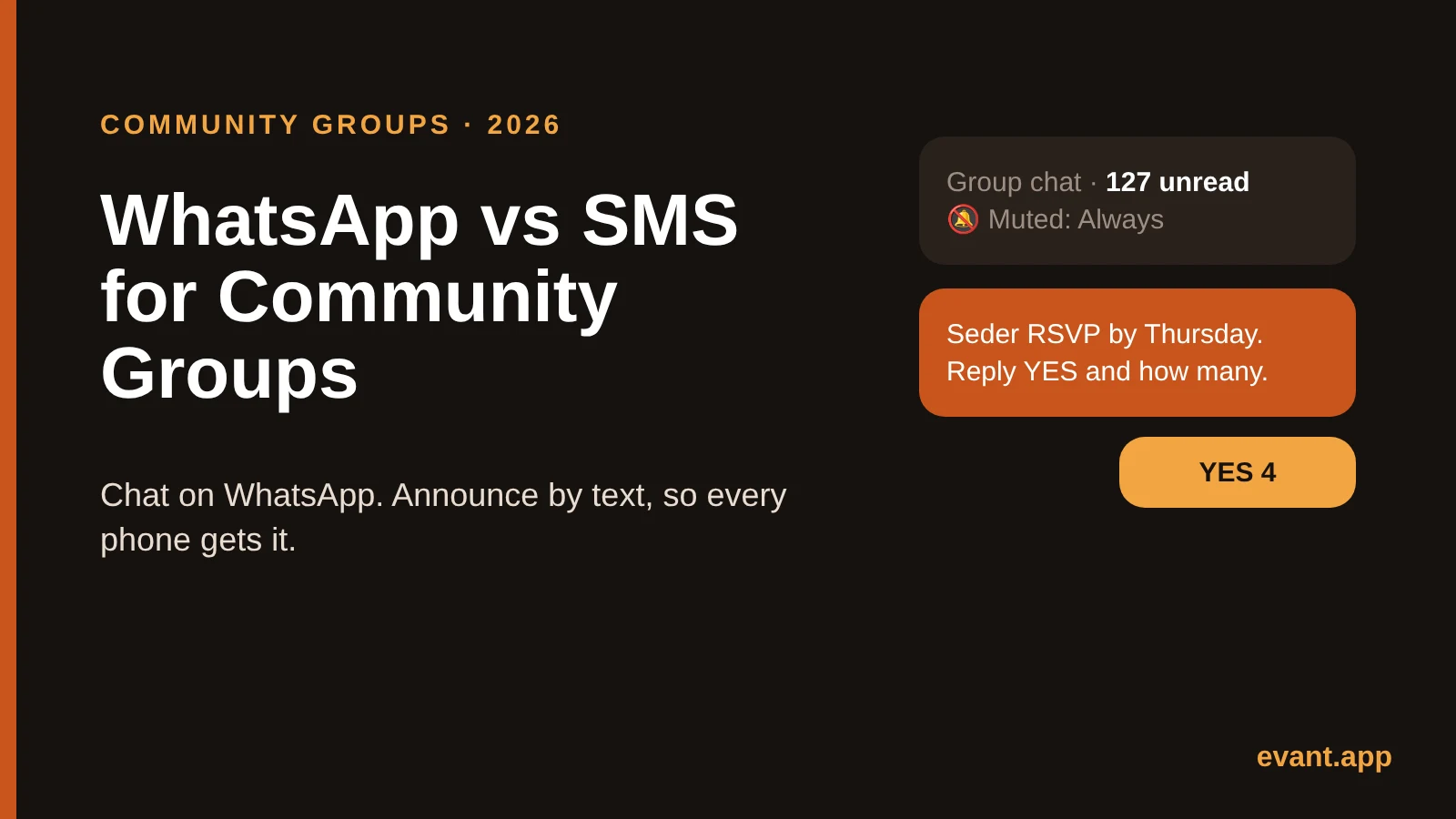
For most community groups, the honest answer to WhatsApp vs SMS is both, for different jobs. WhatsApp is free and good for chatter among members who already use it. SMS reaches every phone, including flip and kosher phones, so it's the safer pick for anything everyone has to see: a schedule change, an RSVP, a Shabbos or Sunday update. If you can only pick one channel for official announcements in the US, pick SMS.
Everyone's on WhatsApp, right?
Not quite. And the people who aren't are usually the ones you most need to reach.
Quick disclosure: I run Evant, a texting platform. I'll tell you where WhatsApp is the better tool, because for some groups it is. Pricing and features checked November 2026.
The short version
- Small group, everyone on smartphones, mostly chatting? WhatsApp. It's free. Use it.
- Every member has to see it, including older members and kosher phones? SMS.
- Want a headcount without scrolling a thread? SMS with "reply YES."
- Lots of members overseas? WhatsApp is probably what they already use.
- A shul, church or nonprofit with a few hundred people? Send announcements by text. Let the WhatsApp group be for the conversation.
WhatsApp vs SMS for community groups, side by side
Features checked November 2026 on WhatsApp's groups page and Evant's own plans.
Where WhatsApp wins
I'll be straight with you. WhatsApp does a lot of things well.
- It's free. Members pay nothing beyond their data.
- Rich media. Photos from the dinner, a voice note from the rabbi or pastor, a video of the kids' choir. No extra cost per message.
- Real conversation. Everyone talks to everyone. For a chesed committee or a small group that likes to chat, that's the whole point.
- Built-in planning. WhatsApp's own groups page lists polls, events and RSVP tracking right in the chat, and says you can invite up to 1,000 people.
- Encryption and international reach. If half your members have family abroad, they're probably on it already.
If your group is 30 people who all have smartphones and like talking to each other, WhatsApp is fine. You don't need me.
Why do people mute WhatsApp groups?
Here's my issue with it. People tell me WhatsApp groups are great for getting members to respond. In practice, people mute WhatsApp groups.
It makes sense. Every reply pings every member. Forty people write "Mazel tov!" and forty phones buzz forty times. So members do the reasonable thing and mute the group. WhatsApp lets them pick 8 hours, 1 week or always.
Always is a long time.
A busy group chat is a crowded kiddush or church potluck. Your announcement is the person tapping a glass in the corner. Some people hear it. Most keep talking.
A text works differently. It shows up in the phone's own messages app, from one number, only when you send something. On an iPhone, iMessage is the only communication app that comes built in, which is why I think a text is the thing people are most likely to open and answer.
Who can't get your WhatsApp message?
WhatsApp needs a smartphone, the app and an internet connection. That leaves people out.
- Basic and flip phones. WhatsApp ended support for KaiOS feature phones, the system on many Nokia flips, in early 2025, per FoneArena.
- Kosher phones. Talk-and-text kosher phones can't run it. I wrote a full guide to kosher phone texting for shuls.
- Americans who just don't use it. About a third of US adults say they use WhatsApp, according to Pew Research Center's 2025 survey. In a US congregation, a lot of your members may not have it at all.
Not everyone has a smartphone. Not everyone has data. Everyone with a cell phone can get a text.
And for the members on landlines, neither works. They need a call. Evant includes voice calls on every plan at 1.5¢ a minute, so a one-minute call to 100 members costs $1.50.
Do you need a group chat, or do you need answers?
Most of what a shul, church or nonprofit sends isn't a conversation. It's an announcement that needs a response.
"Seder RSVP by Thursday." "Men's breakfast moved to 9." "Can you drive a meal to the Cohens tonight?"
In a WhatsApp group, the answers to those land in the same thread as everyone else's jokes and thumbs-ups. Somebody has to scroll and count.
With texting, you send one message and each person answers you. They reply YES. You get a count. Nobody else's phone buzzes.
That's what I built Evant around. Two-way texting, text-to-RSVP, keyword triggers, and scheduled, targeted messages from a dedicated 10-digit number. It works on every phone, including basic, flip and kosher phones, and members don't download anything. Evant isn't exactly a group chat. But for a community, it does very similar jobs.
I walk through what a text RSVP confirmation looks like in the short video below.
One more honest note. Regular WhatsApp is built for people who know each other, not for an organization messaging hundreds of people one by one. Businesses that want that use the WhatsApp Business Platform, which runs on approved templates and per-message pricing, as Mailchimp's comparison explains. For most community groups, that's more setup than it's worth.
How to use both without the chaos
- Decide what's official. Schedule changes, events, RSVPs and giving go out by text. Everyone gets them.
- Keep the WhatsApp group for chatter. Photos, mazel tovs, carpools. Just don't make it the only place news lives.
- Get opt-ins and honor STOP right away. Carriers expect senders to follow the CTIA messaging principles, and a good texting tool takes care of A2P 10DLC registration for you. Evant handles it.
- Use one number. Members save it once and know it's you.
- Call the landlines. Same message, read out loud.
- Post the text number in the WhatsApp group once. That's how the smartphone crowd opts in too.
If you're replacing a group chat specifically, I put together a page on Evant as a WhatsApp group alternative. If you landed here because GroupMe dropped its SMS feature, see my list of GroupMe alternatives. Comparing broadcast texting tools? Here are the Community.com alternatives, and my roundup of the best SMS platforms for churches covers the wider field.
FAQ
Is WhatsApp or SMS better for community groups?
For chatting among members who all have smartphones, WhatsApp is often better: it's free and handles photos, polls and voice notes. For announcements every member has to see, SMS is more reliable in the US, because it reaches every phone without an app and only about a third of US adults use WhatsApp, per Pew Research Center.
Is WhatsApp cheaper than SMS?
For members, yes. WhatsApp is free over Wi-Fi or data. Mass texting tools charge the organization a monthly fee. Evant plans start at $20 a month, with a free trial and no credit card.
Can people without smartphones get WhatsApp messages?
No. WhatsApp needs a smartphone app and internet, and it ended support for KaiOS feature phones in early 2025. Plain text messages reach basic, flip and kosher phones that take texts. Talk-only phones need a phone call.
Why do people mute WhatsApp groups?
Every reply notifies every member, so busy groups get noisy fast. WhatsApp lets members mute a group for 8 hours, 1 week or always, and muted announcements often sit unread.
So which should your community use?
Use WhatsApp for the conversation. Use SMS for the announcement.
If everyone in your group has a smartphone and loves to chat, a WhatsApp group might be all you need. If you have older members, kosher phones, or anyone who muted the group in 2024 and never came back, send the important stuff by text.
At the end of the day, the best channel is the one every member actually gets.
👉 Start your free trial. No credit card.
Related Blogs


I Built a Texting Platform for Small Churches. Here's Where It Falls Short.
Michael PedoeemA founder's honest review of Evant for small churches: free donation link and RSVPs built in, replies, SMS that reaches everyone, and where it falls short.
Eruv Status Text Alerts: How to Tell Every Member Before Shabbos (2026)
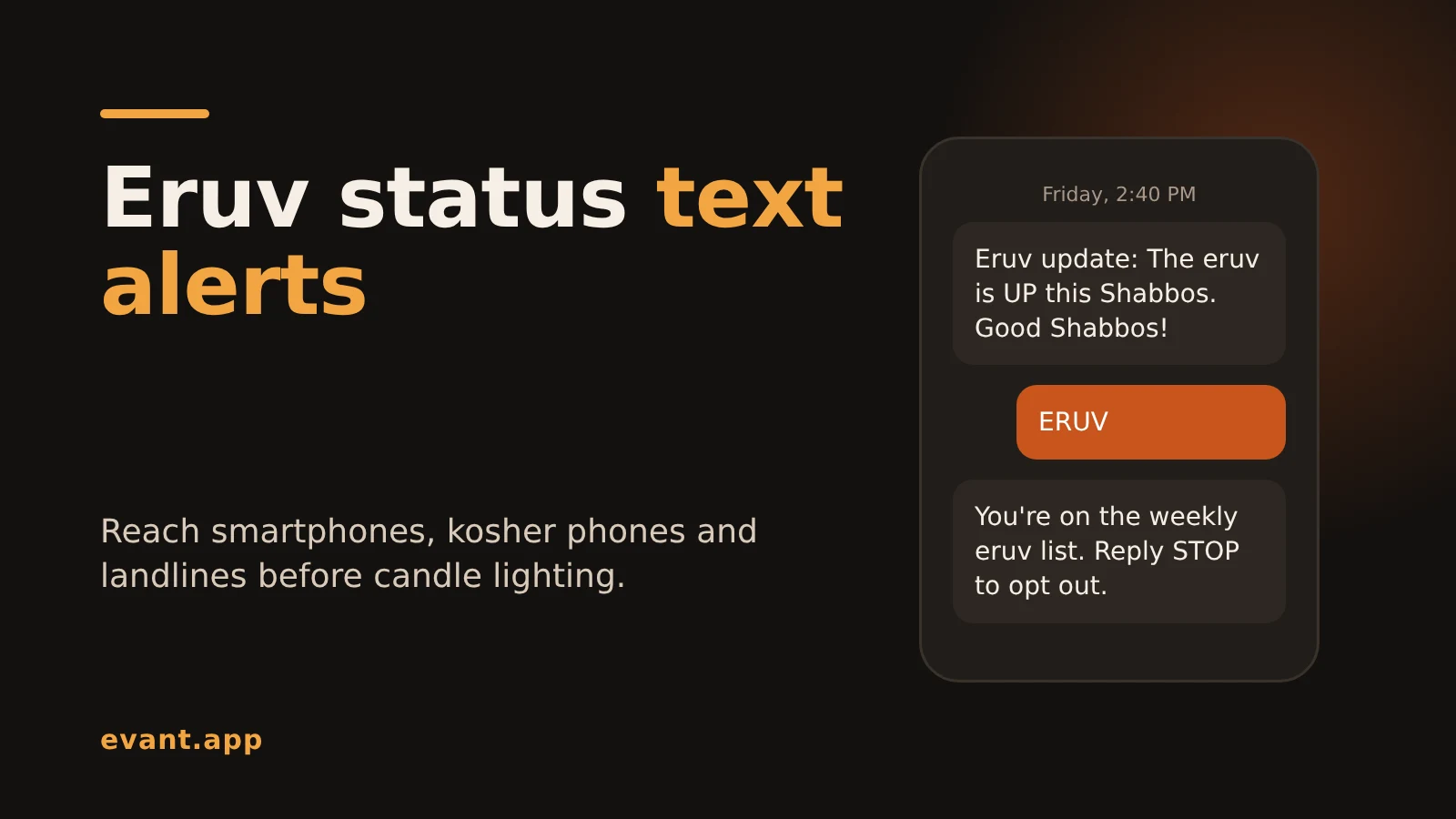
Michael PedoeemHow to send eruv status text alerts every Friday that reach smartphones, kosher phones and landlines, with free and paid options compared and copy-ready texts.
ShulCloud SMS Alternatives: 4 Ways to Text Your Shul That Members Can Answer (2026)
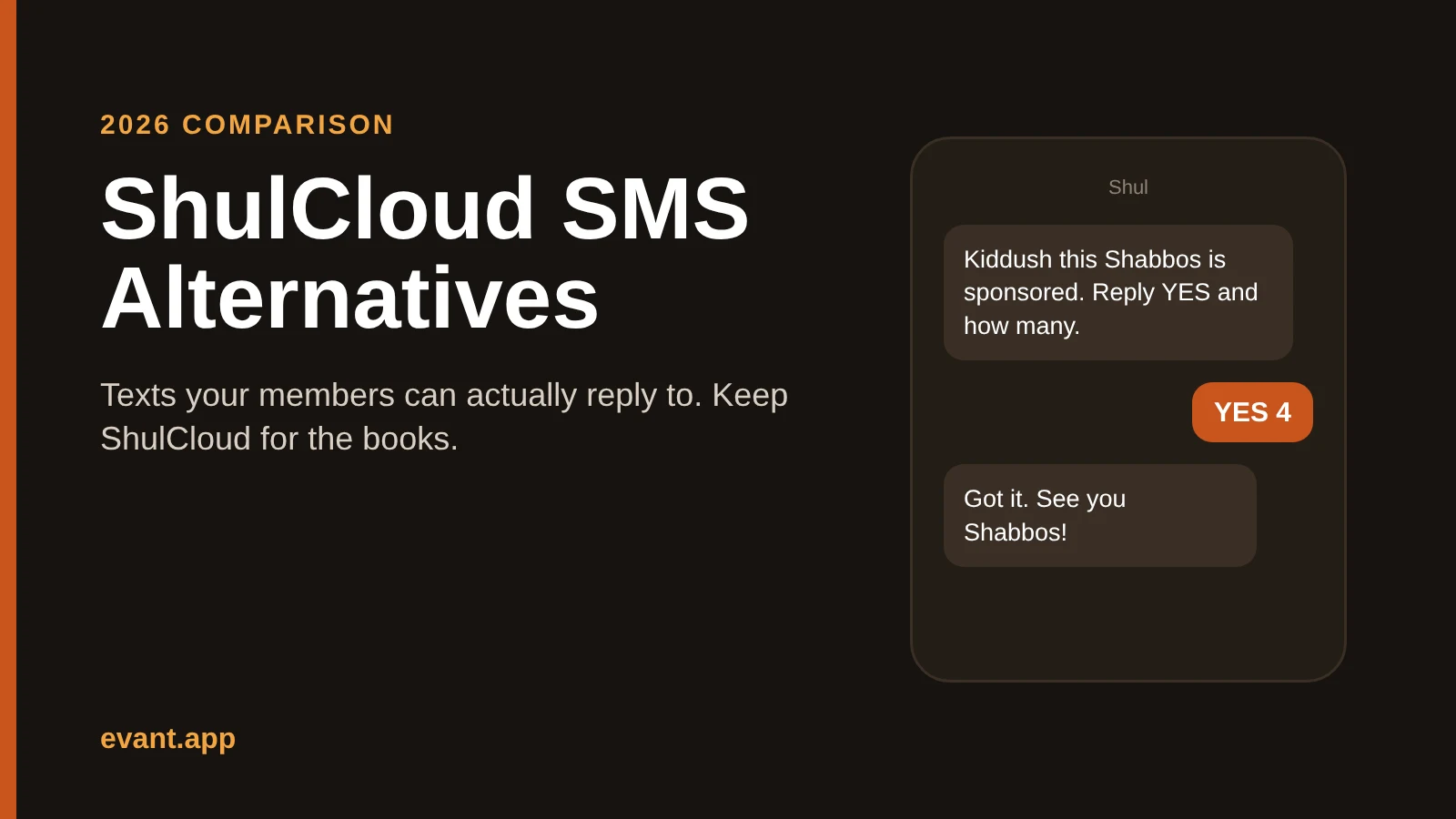
Michael PedoeemShulCloud's texting sends from a no-reply number. Evant, Text-Em-All, Clearstream and WhatsApp compared for shuls that want members to text back.





Get the Evant app



