Eruv Status Text Alerts: How to Tell Every Member Before Shabbos (2026)
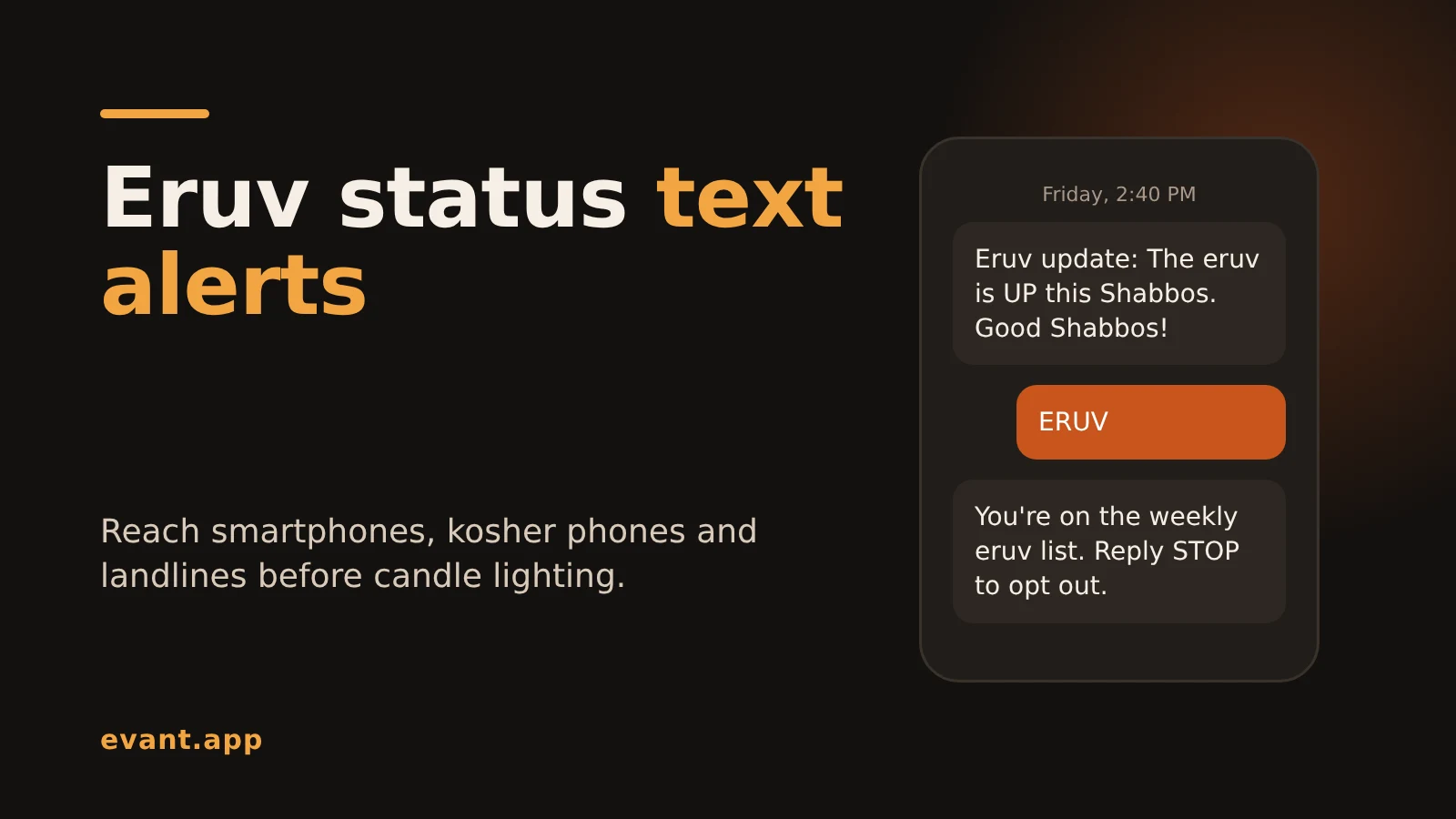
The simplest way to send eruv status text alerts is one plain text every Friday from a single shul number, sent to people who opted in, plus a short phone call for members on talk-only phones. Free eruv alert services and WhatsApp groups work for smartphone users. A two-way texting tool covers everyone else, and lets people sign up by texting one word.
Is the eruv up?
Quick disclosure: Evant is my company. I'll point out where the free options are good enough, because for a lot of eruvin they are. Pricing and features checked November 2026 on each provider's own site.
The quick version
- Small eruv, everyone on smartphones? A free service like EruvStatus or Eruv Alerts, or a WhatsApp group, will do the job.
- Lots of kosher phones? Send plain texts with no links, and call the members whose phones can't take texts at all.
- Your shul already runs ShulCloud? Its SMS add-on can send "the eruv is down." Nobody can reply to it.
- Want sign-ups by text, replies, and a way to collect eruv dues? That's where a two-way tool like Evant fits, from $20 a month.
Why eruv status text alerts beat the hotline
An eruv is a porch light. Nobody notices it until the one week it's off.
And the responsibility sits with each person, not the committee. The Skokie eruv's page puts it plainly: it's the obligation of each individual who wants to carry to confirm, every Friday, that the eruv is working. Chabad.org's explainer on the eruv notes that the groups who maintain one usually post the status by phone or on a website.
So the old setup is a hotline and a webpage. Both make people go looking.
A text flips that around. The status shows up on the phone they already have in their pocket, before candle lighting, without anyone dialing anything.
How communities send eruv alerts today
I looked at how real eruvin handle this right now. Most use three or four channels at once, which tells you none of them reaches everybody.
- Los Angeles runs an email list, Facebook, Twitter, a phone line, and a weekly WhatsApp status message.
- Highland Park/Edison uses Twitter, email, Facebook, a website and a hotline, according to Congregation Etz Ahaim.
- Rockland asks people to text MYERUV to a short code to get weekly eruv status alerts on their phone.
Rockland has the right idea. One word.
Your options, side by side
Pricing and features checked November 2026 on EruvStatus, Eruv Alerts and ShulCloud's help center. US pricing.
Free eruv alert services
I'll be straight with you. If your eruv is listed on one of these, your members might not need anything else.
EruvStatus lets subscribers pick email, text, or both, and the local eruv administrator publishes the status. It doesn't list a price, so ask them.
Eruv Alerts is free to join. You sign up through a form and get a message with your eruv's status an hour or more before Shabbos, including last-minute changes. US only.
Where they fall short: they're built for one job. If the committee also wants to collect dues, thank sponsors, or call the 80-year-old with a talk-only phone, that happens somewhere else.
A WhatsApp group
Free and easy. Also the first thing people mute. And a WhatsApp group can't reach anyone on a basic or kosher phone, which in a lot of frum neighborhoods is exactly the group that relies on the eruv most. I went deeper on this in my guide to kosher phone texting for shuls.
ShulCloud's SMS add-on
If the eruv is run out of a shul that's already on ShulCloud, this is the path of least resistance. ShulCloud's own help center uses "the eruv is down" as an example. It's $37.99 a month including 2,000 messages, extra messages are $10.99 for 650 credits, and unused credits expire monthly.
One text a week to 300 subscribers is about 1,300 texts a month, so most eruvin stay under the cap.
The catch is that texts go out from a no-reply number. Nobody can text back "ERUV" to join, or ask whether the north side is covered. I compared the tools that take replies in ShulCloud SMS alternatives.
Evant
This is the one I built. Here's what's relevant for an eruv committee.
You get a dedicated 10-digit number. People text a keyword like ERUV to that number and they're on the list. No form. No app. Then every Friday you send one scheduled, targeted text to that list.
It works on every phone, including basic, flip and kosher phones. For members whose phones can't take texts at all, send a voice broadcast from the same account. Voice calls are on every plan at 1.5¢ a minute, so a one-minute call to 100 members is $1.50.
And the part the alert-only tools skip: eruvin cost money to check and repair. Every Evant customer gets a customizable Stripe donation page at no extra charge, with recurring payments and a fundraising progress bar. Good for annual eruv dues or a weekly sponsorship.
Eruv status text templates you can copy
Keep them short. Keep them plain. No pictures, and no links for the kosher phone crowd.
- Eruv up: "Eruv update from [Shul]: The eruv is UP for Shabbos. Good Shabbos! Reply STOP to opt out."
- Eruv down: "Eruv update from [Shul]: The eruv is DOWN this Shabbos. Please do not carry. Good Shabbos."
- Not checked yet: "Eruv update: The eruv has not been checked yet. We'll text again by [time]."
- Yom Tov: "Eruv update for Yom Tov starting [day]: The eruv is UP. Chag sameach!"
- Sponsorship: "This week's eruv is sponsored by [name] in honor of [occasion]. Want to sponsor a week? Reply SPONSOR."
- Sign-up confirmation: "You're on the [Shul] eruv list. One text each Friday, plus Yom Tov. Reply STOP to opt out."
Notice the "not checked yet" text. Sending it beats silence. Silence at 3pm on a winter Friday makes people nervous.
How to set up eruv status text alerts in an afternoon
- Pick one number and stick with it. Members save it as "Eruv" once.
- Get opt-ins first. A keyword sign-up, a form at the shul, or a list of people who already asked. Carriers expect senders to follow the CTIA messaging principles, so honor STOP right away.
- Put the sign-up word everywhere. The shul bulletin, the eruv map, the hotline recording. A free SMS QR code generator turns "text ERUV" into something people scan off a flyer.
- Schedule the Friday text the moment the checker signs off. Same time window every week, so people learn when to expect it.
- Call the talk-only phones. Same message, read out loud.
- Ask for dues twice a year, not every week. Nobody wants a fundraising pitch inside a halachic update. If you're adding giving, my rundown of text-to-give for synagogues covers the options.
For the bigger picture on texting tools for shuls, schools and Chabad houses, see my ranking of the best SMS platforms for Jewish organizations.
FAQ
How do I find out if the eruv is up?
Check with your local eruv committee every Friday. Most post the status on a website or hotline, and many send weekly email or text alerts you can sign up for.
Can I get eruv status by text message?
Yes, in many communities. Some eruvin send their own texts, some use services like EruvStatus or Eruv Alerts, and Rockland's eruv asks people to text MYERUV to a short code to sign up.
Do eruv alerts work on kosher phones?
Plain text alerts reach kosher phones set to talk and text. Talk-only phones can't receive texts, so those members need a phone call or the hotline. WhatsApp alerts need a smartphone.
How much does it cost to send eruv text alerts?
Free services exist for subscribers. ShulCloud's SMS add-on is $37.99 a month including 2,000 messages. Evant plans start at $20 a month and include voice calls at 1.5¢ a minute.
So what's the right way to text your eruv status?
One number. One word to sign up. One plain text every Friday. A phone call for the members who can't get it.
If a free alert service already covers your eruv, use it. If you also want replies, calls and a way to fund the thing, put it all in one place.
At the end of the day, an eruv only helps the people who know it's up.
👉 Start your free trial. No credit card.
Related Blogs
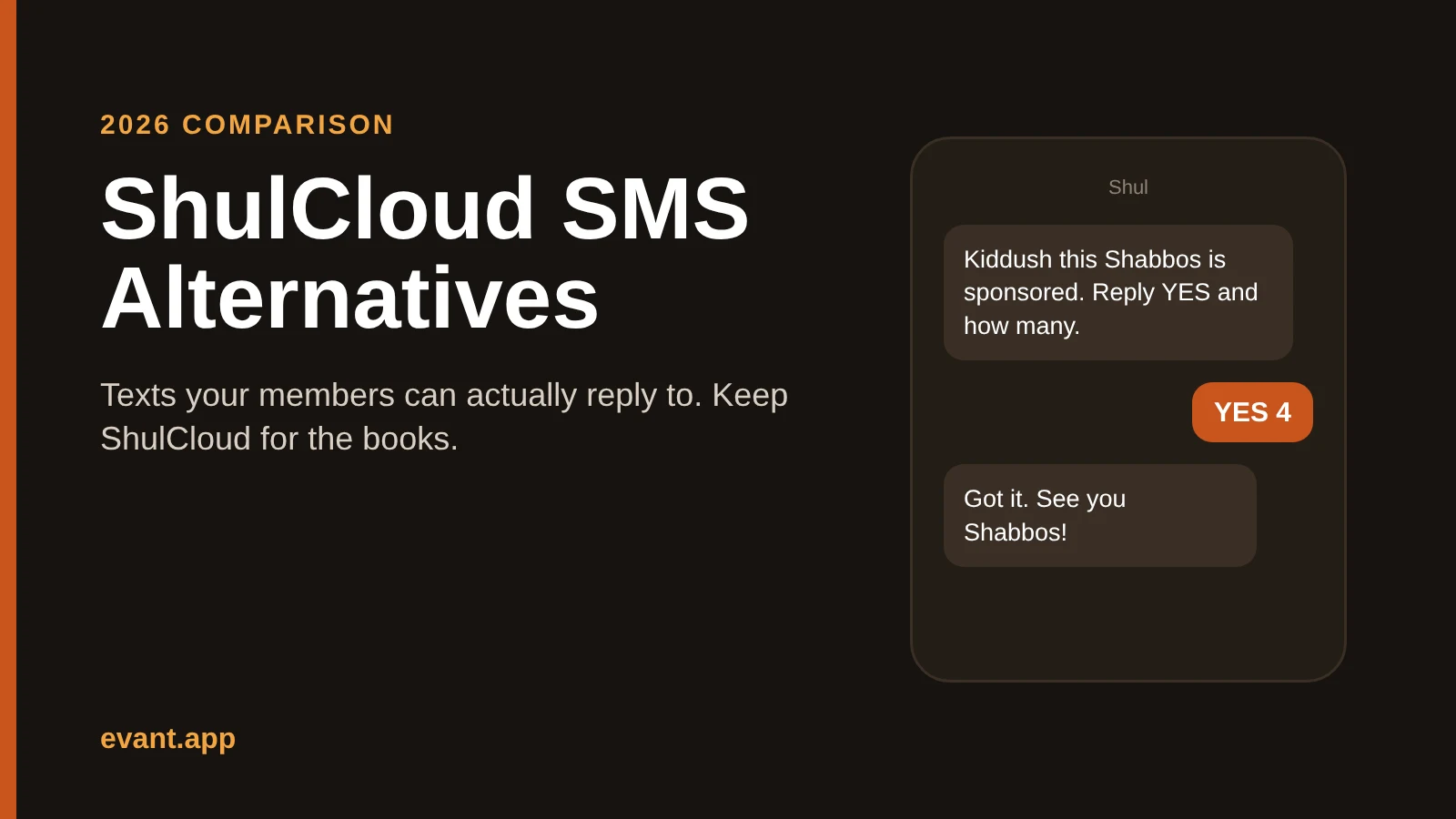

ShulCloud SMS Alternatives: 4 Ways to Text Your Shul That Members Can Answer (2026)
Michael PedoeemShulCloud's texting sends from a no-reply number. Evant, Text-Em-All, Clearstream and WhatsApp compared for shuls that want members to text back.

Remind Alternatives for Churches: 4 Options That Still Text Your Members (2026)
Michael PedoeemFree Remind no longer texts most church groups. Remind Hub, Flocknote, Clearstream and Evant compared on price, texting and voice calls.
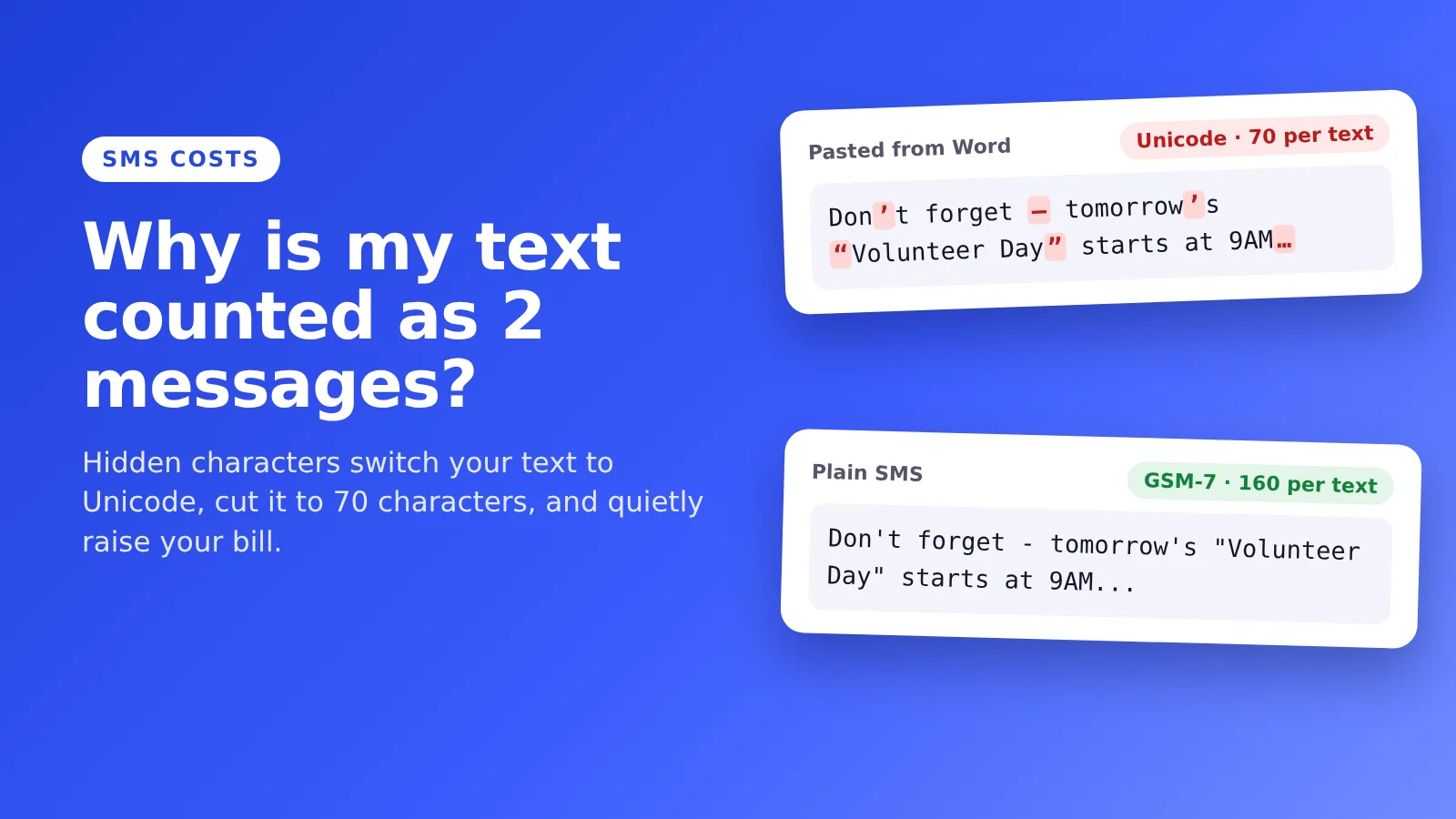
Why Is My Text Message Split Into Multiple Messages?
Michael PedoeemOne curly apostrophe can turn one text into two. Here's why hidden characters split your messages and raise your SMS bill, and how to fix them in seconds.





Get the Evant app



