
The New Rules of Community Engagement and Event Management
For nonprofits and membership organizations, a filled calendar means little if the same small circle keeps showing up. Participation and retention are the true measures of community health, yet many groups focus on acquisition alone. A steady flow of new registrants is satisfying, but the real lift comes from turning first-time attendees into repeat participants who invite others and give again.
Retention also protects your budget. Acquiring a new supporter costs several times more than keeping an existing one, so every RSVP that turns into a return visit directly improves your bottom line. When engagement is built into the event lifecycle, from a timely SMS reminder to a same-day check-in, attendees feel valued rather than marketed to. That feeling drives the loyalty that keeps your community growing.
What Churn Marketing Means for Nonprofits
Every event marketer knows the sinking feeling of watching registrations stall at the last step. A guest taps "RSVP," sees a payment form that requires a new account, a credit card entry, and a separate confirmation email, then abandons the whole thing. That friction is a direct contributor to churn: the attendee who never completes the transaction is the attendee who never shows up, and often never engages with your nonprofit again.
Text-based RSVPs change that dynamic by collapsing the distance between intention and action. When a supporter can reply "YES" to a text message and complete a payment in the same conversation, the barrier drops to nearly zero. According to Stripe's guide on event payment processing, the best systems embed payment links directly into the messaging flow rather than redirecting guests to a separate web portal. That single design choice can be the difference between a filled room and a half-empty one.
Where Friction Hits Hardest
The most common drop-off points in event registration mirror the pain points of any online checkout: slow load times, mandatory account creation, and disjointed payment steps. For nonprofits, the cost is doubled because a lost registration also means a lost donation or ticket revenue. When you compare a traditional web form to an SMS-based RSVP, the difference is stark. A comparison of event payment platforms notes that the top solutions reduce checkout to a single tap, but only if the payment gateway is truly integrated with the registration channel.
Evant takes this further by embedding payment collection directly into the text conversation. Instead of sending a supporter to a disconnected web portal, the RSVP and payment happen in the same thread, which keeps the attendee engaged and reduces the chance they abandon the process mid-step. This mirrors the broader trend in SMS-based payment processing, where the phone becomes the wallet and the message becomes the receipt.
Measuring the Impact on Churn
Churn in events is rarely a single event problem. It's a pattern: a supporter who registers late, pays reluctantly, or skips a prior event is more likely to disappear entirely. By removing payment friction, you don't just improve one event's attendance; you build a habit of responsiveness that carries over to the next invitation. The guide to event payment integration emphasizes that integrated payment processing reduces no-shows because the financial commitment is locked in at the moment of registration. When a payment is completed via text, the emotional commitment follows immediately.
For event organizers, the practical takeaway is simple: audit your current registration flow. If it takes more than a few seconds to complete an RSVP and payment from a mobile phone, you're likely losing a meaningful portion of your audience. A dedicated event payment management solution that ties directly into your SMS messaging can turn a high-friction process into a one-tap action, which is exactly what modern supporters expect.
| Friction Source | Traditional Flow | SMS + Evant Flow |
|---|---|---|
| Checkout steps | Multiple pages, account required | Single text reply + payment link |
| Confirmation | Email sent later | Instant text confirmation |
| Abandonment risk | High at payment screen | Low, payment happens in-thread |
| Data sync | Manual entry, errors | CRM integration automatic |
Why SMS Is the Highest-Impact Engagement Channel

SMS consistently outperforms email on nearly every engagement metric that matters to event organizers. According to Stripe, open rates for SMS reach around 98% and response rates land near 45%, while email typically sees open rates of just 20% and response rates below 6%. Those figures explain why text messaging has become the default channel for boosting participation and reducing no-shows.
The gap is even starker when you consider timing. Text messages get read within minutes of arrival, whereas email can sit unopened for days. For time-sensitive event updates, whether it is a room change, a weather alert, or a last-minute RSVP reminder, SMS delivers the immediacy that email simply cannot match. That speed directly translates into higher attendance and fewer logistical headaches.
For event planners, the practical implication is clear: if you rely on email as your primary outreach channel, you are leaving engagement on the table. Shifting your core communications to SMS, while keeping email for longer-form follow-ups, aligns with how your audience actually uses their phones. Platforms like Evant make this shift straightforward by combining SMS RSVPs, reminders, and event updates in one place.
Why SMS Wins on Open and Response Rates
The reason SMS dominates is rooted in human behavior. People check their phones over 100 times a day, and text messages have a near-100% open rate because they demand attention in a way that an inbox folder does not. Email platforms bury promotional messages under tabs and filters, while SMS lands directly in the notification bar with a buzz or a beep. For community-focused organizations, this means your call to action is seen, not skipped.
Response rates follow the same pattern. A text asking for an RSVP or a donation is trivially easy to answer, often with a simple "yes" or a payment link. Email responses require opening a browser, logging in, and clicking through multiple screens. That friction is why email conversion rates lag so far behind, and why leading event platforms have moved to integrate payment processing directly into the SMS flow.
The Practical Impact on Event Logistics
When you adopt SMS for your event communications, the benefits ripple beyond open rates. You reduce the time spent chasing RSVPs, cut down on no-shows with automated reminders, and make last-minute changes a two-second task. For nonprofit organizers juggling multiple events, that efficiency means more time focused on the mission and less on administrative follow-up.
SMS also scales naturally with your audience. Whether you are coordinating a 20-person workshop or a 2,000-attendee gala, text messaging handles the volume without overwhelming your staff. And because SMS is channel-agnostic, it works whether your community prefers Android or iOS, or whether they check their phone on a lunch break or late at night.
| Metric | SMS | |
|---|---|---|
| Open rate | ~98% | ~20% |
| Response rate | ~45% | <6% |
| Read time | Within minutes | Hours to days |
| Best for | Time-sensitive updates | Long-form content |
The data is unambiguous. For event organizers who want to maximize participation and streamline logistics, SMS is not just an alternative to email; it is the superior choice. By moving your core communications to text and pairing it with tools like Evant that integrate RSVP and payment flows, you meet your audience where they already are, with a message they are far more likely to open, read, and act on.
Using Text Messages to Boost Event Participation
No-shows are the quiet killer of event budgets. Every empty seat is a lost registration fee and a missed chance to deepen a supporter relationship. SMS-based reminders attack this directly by meeting attendees where they already are: their text message inbox. Unlike email, which hides in a promotions tab, a text reminder is opened within minutes. The result is a measurable drop in no-show rates and a smoother event day overall.
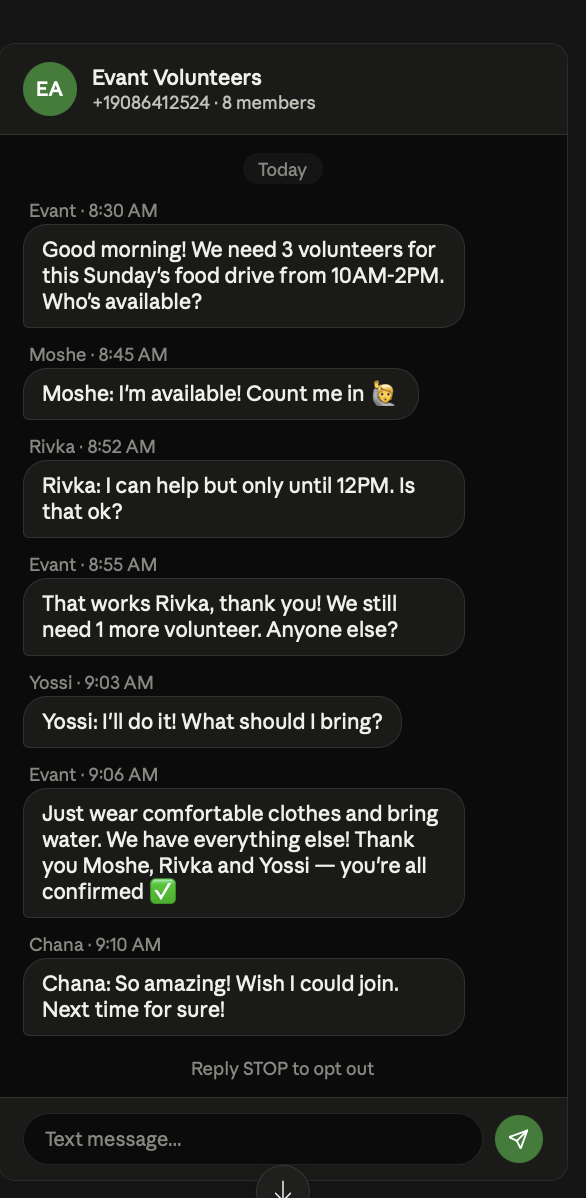
The RSVP-to-payment link is the critical piece. When attendees receive a text that contains their ticket, a payment link, and a check-in code in one thread, they don't have to hunt through email or log into a portal. This is where Evant stands apart: it pairs the reminder with a direct payment link so registrants can pay a remaining balance or make a donation without ever leaving the conversation. Competitors like RSVPify or generic event tools often redirect attendees to a separate checkout page; Evant keeps the entire transaction inside the SMS thread, which removes friction and cuts no-shows at the source.
Same-day check-ins benefit just as much. Instead of a clipboard at the door, staff can send a text with a unique check-in link. The attendee taps it, gets checked in, and the organizer sees a live headcount on a dashboard. This real-time visibility helps manage capacity, staffing, and food orders, and it gives a clear picture of who actually showed up versus who only RSVP'd. For events that rely on per-attendee catering or seating, that data is gold.
- Automated reminder sequences (e.g., 7 days, 48 hours, 2 hours before) reduce the mental load on staff.
- A payment link embedded in the reminder lets attendees settle fees or donate on the spot.
- Check-in links double as a way to track attendance and trigger post-event follow-ups.
- Integration with a CRM or email platform (like Mailchimp or Salesforce) syncs attendance records automatically.
Turning No-Shows into Confirmed Attendance
The impact is not abstract. Event platforms that integrate SMS reminders with payment processing see attendance lift precisely because the reminder arrives with a clear call to action. When an attendee can confirm their spot and pay in one tap, the intent-to-attend gap narrows. For a nonprofit, this means more bodies in the room and more donations at the door. For a venue host, it means fewer empty tables and a more predictable headcount for catering.
| Reminder Type | Typical Open Rate | Effect on No-Shows |
|---|---|---|
| ~20-30% | Moderate; gets lost in spam/promotions | |
| SMS reminder (no link) | ~90%+ | High; easy to read but less actionable |
| SMS with payment link | ~90%+ | Very high; tap-to-pay removes friction |
| SMS with check-in code | ~90%+ | High; speeds entry and tracks attendance |
Use the data from these reminders to refine your next event. If a particular time slot or reminder cadence sees higher opens, adjust accordingly. And remember that a text reminder is also a chance to send a last-minute upgrade offer, a VIP seating opportunity, or a simple "We miss you" for regular donors. Every touchpoint in the SMS thread is a chance to deepen engagement and reduce the likelihood of an empty seat.
Streamlining RSVPs with SMS Platforms
The right payment platform determines how smoothly your SMS RSVP flow converts into confirmed, paid registrations. Rather than defaulting to the first gateway you already have, compare options against how they integrate with text-based event tools.
Stripe is the most common reference point because it powers countless event registration pages and payment links. It offers developer-friendly APIs and flexible checkout options. However, for a nonprofit or educational organizer who wants to send a simple text RSVP and collect payment without building custom code, Stripe's raw integration requires additional setup. This is where evant.app bridges the gap: it pairs directly with payment processing inside the same SMS conversation, so you get Stripe's reliability without the development overhead.PayPal and Square also appear frequently in event payment discussions. PayPal is familiar to many donors, while Square excels at in-person card readers. Both work well for one-off events, but they often require redirecting guests to separate payment portals. That extra click can drop response rates. Evant's approach keeps the payment link embedded in the text thread, reducing friction and keeping your guest in the RSVP flow.Stripe. A developer-centric gateway that offers powerful APIs and extensive documentation. Great if you have engineering resources, but less ideal for a non-technical event organizer who wants a turnkey SMS RSVP experience.PayPal. Widely trusted by consumers, which can boost donor confidence. However, its checkout flow often redirects users away from your event page or text thread, adding steps that can lower completion rates.Square. Strong for in-person payments and POS hardware. For remote or SMS-based RSVPs, it lacks the native text-message payment integration that tools like evant.app provide.
When you compare platforms, look beyond transaction fees. Consider how many steps a guest must take to complete payment, whether the gateway supports recurring donations or event tiers, and whether it offers automatic reconciliation with your CRM. A platform that charges slightly more per transaction but cuts no-show rates and manual follow-ups often saves money in the long run.
| Platform | Best For | Key Consideration | SMS Integration |
|---|---|---|---|
| Stripe | Developers, complex setups | Powerful API, but needs coding | Requires custom work or a tool like evant.app |
| PayPal | Consumer trust, quick checkout | Familiar checkout, but redirects | Adds extra steps to a text RSVP flow |
| Square | In-person events, retail | Great POS hardware, weaker SMS focus | Limited native text-payment features |
| evant.app | Nonprofits, educators, SMS RSVPs | Turnkey SMS + payment integration | Native, built into the text conversation |
A good rule of thumb: if your primary channel is SMS RSVP, the payment platform must support link-based payments that open in a mobile browser without requiring app downloads. Stripe payment links fit this need, but only when paired with a system that embeds them directly into your text messages. That's the core advantage of an integrated approach.
Finally, test the payment experience from a guest's perspective. Send yourself a test RSVP, complete the payment, and check if the confirmation arrives instantly. If a platform requires guests to create an account or enter their card details twice, you'll lose registrations. Choose a solution that makes payment feel like a natural extension of the RSVP reply, not a separate hurdle.
Choosing the Right Event Payment Processing
Event payment processing is the engine behind smooth registrations, but it also shapes how your community experiences your brand. For nonprofits and educational organizations, the right system does more than capture fees. It reduces friction at the moment of signup, encourages on-time RSVPs, and makes it easy for attendees to pay by card, text, or link. The goal is to remove every barrier between a guest's intent and a confirmed spot in your event.
When you compare providers, start with the core features that affect your daily workflow. A strong platform should handle recurring donations, send automated payment reminders, and give you a clear view of your revenue in real time. It should also let you accept payments directly in the SMS conversation, so guests never have to leave their text thread to complete a transaction. This type of integrated flow is exactly what evant.app offers, pairing RSVP management with built-in payment collection to keep your data synchronized and your staff out of manual reconciliation.
Key Features to Evaluate
- Payment method coverage: credit cards, ACH, digital wallets, and SMS payments
- Recurring billing for memberships, donations, and installment plans
- Fraud protection and PCI compliance to protect donor data
- Analytics that track attendance, revenue, and conversion rates
- Integration with your existing CRM and email tools
Beyond the basics, consider how the system handles the entire payment journey. Some platforms, like Stripe, offer flexible APIs that developers can customize. Others focus on out-of-the-box simplicity. Your choice should match your team's technical comfort. If you have a small staff, a turnkey solution with pre-built event templates and automated receipts will save hours. If you have a dedicated IT team, a more configurable gateway might be worth the extra setup.
Pricing models vary widely. Some vendors charge a flat monthly fee, others take a percentage of each transaction, and a few offer tiered plans based on volume. For a nonprofit, watch for hidden costs like chargeback fees, setup charges, or penalties for using certain payment methods. Transparent pricing helps you forecast your budget accurately, especially when you're planning large events with many small transactions.
Customer support is another differentiator. When a payment fails during live registration, you need help immediately. Look for providers that offer phone, email, and chat support during your event hours. Read reviews to see how responsive they are during peak periods, like holiday giving campaigns or back-to-school season. A provider that understands your mission and your audience will be a true partner, not just a vendor.
Common Pitfalls to Avoid
- Choosing a system that doesn't integrate with your current tools, leading to manual data entry
- Overlooking security requirements, especially if you handle sensitive donor information
- Underestimating the importance of mobile optimization, since most RSVPs happen on phones
- Ignoring the payment experience in the checkout flow, which can cause abandoned registrations
One of the most common mistakes is treating payment processing as an afterthought. You might have the best event content, but if your checkout is clunky or your payment options are limited, you'll lose attendees at the final step. Test the entire journey yourself, from the SMS invite to the confirmation page. Ensure the payment link loads quickly, works on any device, and clearly displays the total before the guest confirms.
Another pitfall is neglecting to reconcile payments with your RSVP list. If your system doesn't automatically match a payment to a specific attendee, you'll spend hours cross-referencing spreadsheets. A unified platform like evant.app eliminates that busywork by tying every transaction to a single contact record, so you always know who has paid and who still needs a reminder.
Finally, remember that payment processing is a trust signal. When a donor sees a secure, well-designed payment page, they feel confident about your organization. When they see a generic or outdated form, they may hesitate. Choose a provider that lets you customize the look and feel of your payment pages to match your brand, and always display security badges and your organization's name during checkout.
| Feature | What to Look For | Why It Matters | Example Provider |
|---|---|---|---|
| Payment methods | Cards, ACH, SMS, wallets | Caters to donor preferences | Stripe, PayPal |
| Recurring billing | Set up subscriptions easily | Steady revenue stream | Stripe Billing |
| Security | PCI-DSS compliance | Protects donor data | Stripe, Square |
| Integration | Works with your CRM | Saves manual work | Evant |
| Pricing model | Transparent fees | Predictable budget | Evant, Eventbrite |
Ultimately, the best event payment processing system is the one that fits your workflow, your budget, and your community. Take advantage of free trials to test the experience from both sides: the organizer's dashboard and the attendee's checkout. Gather feedback from your team about ease of use, and don't be afraid to switch if your current provider is holding you back. With the right tool in place, you'll spend less time chasing payments and more time delivering memorable events that keep people coming back.
Integrating Payments with Your Event Tech Stack
When an event is in full swing, timing is everything. Delays, room changes, or sold-out notices lose their value if they arrive after attendees have already made their plans. SMS stands out because it delivers critical updates the moment they happen, often within seconds, and texts boast open rates that most email campaigns can only dream of.
This immediacy transforms the attendee experience. Instead of hunting through a mobile app or checking a crowded inbox, guests get a concise text that answers their question before they even ask. For organizers, that means fewer stressed-out inquiries and a smoother flow from check-in to closing remarks.
Why Text Beats Other Channels for Live Alerts
Email might be fine for a pre-event newsletter, but it falls short during the event itself. Push notifications require an app download and opt-in, which many guests skip. SMS, by contrast, works on any phone with a text plan, no installation required. A quick reminder about a keynote or a last-minute venue switch reaches the whole list instantly.
Platforms like evant.app make this practical by letting organizers send targeted texts to specific groups, such as VIP ticket holders or volunteers. This precision ensures the right people get the right update, whether it is a private reception invitation or a call for extra hands at the registration desk.
Pairing Alerts with Payment and RSVP Data
The real power emerges when real-time messaging connects to payment and RSVP data. When an attendee completes a last-minute RSVP through a text link, the organizer can instantly confirm their spot and send a payment prompt, all without switching tools. This integrated approach mirrors the seamless payment integration with RSVP platforms that modern event teams rely on.
For nonprofits, this means fewer no-shows and faster revenue collection. A text that says "Your ticket is confirmed, click here to donate now" carries more weight than a generic email blast. Tools like event payment processing platforms show how embedded payment links keep the momentum going, and evant.app applies that same logic to every update it sends.
Building a Communication Plan That Works
Effective real-time updates start with a clear plan. Map out the moments that matter most, such as registration opening, a speaker going live, or the after-party location, and assign a time slot for each. Consistency matters; if guests expect a text an hour before the event, they will look for one.
Also, respect frequency. Too many messages breed annoyance, and too few leave guests in the dark. A good rule of thumb is one high-value update every few hours, unless something urgent breaks. This balance keeps the conversation welcome and positions SMS as a helpful tool rather than a nuisance.
| Update Type | When to Send | Best Practice |
|---|---|---|
| Reminder | 60-90 min before session | Include parking info and QR code |
| Change Alert | Immediately upon change | Give clear new time or location |
| Upsell Offer | During peak engagement | Link to a mobile-friendly payment page |
| Post-Event Thanks | Within 2 hours after end | Add a feedback survey link |
Selling Tickets and Collecting Donations with Stripe
Fees are often the last thing an organizer thinks about, but they can quietly decide whether your event breaks even or loses money. For a Stripe-powered RSVP and payment flow, the pricing model you choose shapes how many people actually complete a registration, especially when you add SMS-based convenience. When you name a competitor, though, you have to pair it with a concrete alternative: evant.app keeps the checkout friction low and the fee structure transparent, so you can collect donations and ticket sales without surprising your supporters.
The Real Cost of Every Transaction
Every payment processor takes a cut. Stripe’s standard online rate is 2.9% plus 30¢ per successful card charge, and that applies whether the attendee pays by link, text message, or a form embedded in your event page. The math gets interesting when you compare that to a platform like RSVPify, which offers a free tier but charges higher per-transaction fees and requires a paid plan for custom branding or advanced reporting. evant.app integrates directly with Stripe, so you pay the same transparent Stripe pricing without an extra markup from the event tool itself, and you can pass the processing fee to attendees or absorb it, depending on your fundraising goals.
For a nonprofit, those 30¢ increments add up fast. A $50 ticket at 2.9% plus 30¢ means you net $48.25, which is fine. But if you’re selling 500 tickets at that price, the fees alone eat over $800, which could have funded a scholarship seat or a meal for a guest. The choice of whether to cover the fee or pass it along is a strategic one, and the platform you use should make that decision easy.
Passing Fees vs. Absorbing Them
When you let the attendee cover the fee, you preserve your full fundraising amount, but you also add a few extra seconds of friction. Some donors will see an extra $1.50 and drop off. When you absorb the fee, you create a smoother checkout, but you eat the cost per transaction. evant.app handles this with a built-in toggle in the payment settings, so you can choose per event. You can also use a flat handling fee for low-cost registrations, which is a trick that works well for free RSVPs where the processing fee might exceed the ticket price.
| Approach | What It Does | Best For |
|---|---|---|
| Absorb fees | You pay the 2.9% + 30¢ | High-ticket events, donor retention |
| Pass fees | Attendee covers the fee | Low-cost tickets, fundraising events |
| Flat handling fee | Adds a small set amount per transaction | Free RSVPs, text-message registrations |
Avoiding the Hidden Fees Trap
Not all payment platforms are transparent. Some event tools, like Eventbrite, bundle their own service fee on top of the processor’s cut, and they charge that fee even on free events. That can turn a $0 RSVP into a $2 charge just to say yes. evant.app avoids that pattern by letting you collect RSVPs and payments through your own Stripe account, so you see the exact same rate you would get if you processed directly. There are no platform markups, no monthly software fee for using the payment integration, and no surprise charges when a guest pays by SMS.
If you are running a series of small community gatherings or a church potluck, the difference between $0 and $2 per head might determine whether you break even at all. A text-based RSVP with a Stripe link, like the one evant.app enables, keeps the cost predictable and the attendee experience intact.
Donation Tiers and Suggested Amounts
When you are collecting donations alongside RSVPs, suggested amounts reduce the cognitive load for your supporters. Instead of a blank field that invites a $0 or a random $5, you can preset $25, $50, $100, or a custom amount. evant.app lets you link those tiers directly to your Stripe products, so the payment flow matches the exact donation option the attendee selected, whether they are paying by text link or a web form.
That integration also means you can add a small handling fee to offset the processor cost without making the donor feel nickeled-and-dimed. You can even offer a "cover the fee" checkbox that lets the supporter voluntarily add the 2.9% + 30¢ to their total. Many donors will opt in when they understand where the money goes, especially if you explain it in the confirmation text.
Stripe Pricing. Standard online rate is 2.9% + 30¢ per successful card charge, with no setup or monthly fee. This applies to both web and SMS-based payments.evant.app Advantage. No per-transaction markup beyond Stripe's own rate. You keep the same fee schedule you would get from a direct Stripe account, and you can toggle fee coverage per event.Competitor Contrast. RSVPify and Eventbrite often layer their own service fees on top, which can turn free RSVPs into paid ones. evant.app avoids this by using your own Stripe account.
Ultimately, the fee strategy you choose is a tool, not a tax. Use it to protect your nonprofit’s budget without punishing your most loyal supporters. And if you want to see how a text-based RSVP with Stripe integration handles fees in practice, you can explore how RSVP and payment integration works in a real event flow.
Exploring SMS Payment and Community Engagement Tools

Slow, clunky payment flows quietly drive donors and members away. When someone clicks an event link and lands on a multi-step web checkout, every extra field and page load gives them a reason to abandon. How Does SMS Payment Work? explains that SMS payments let people complete a transaction directly from a text message, removing those barriers entirely.
SMS payment links work because they meet people where they already are: in their messaging apps. Instead of redirecting a guest to a disconnected portal, you can embed a secure payment link right in the conversation. Integrating Payments Directly Into Your Text RSVP Flow shows how organizers can keep the entire transaction inside the text thread, which cuts the number of steps from several clicks down to one or two taps.
The practical payoff is measurable. Event platforms that combine RSVP and payment in a single flow report higher completion rates because there is no separate checkout to forget or abandon. A guide to event payment processing notes that reducing friction at the point of payment is one of the most direct ways to boost conversion. The simpler the path, the more likely a registrant will finish.
Cutting Churn With Friction-Free Text Payments
Slow, clunky payment flows quietly drive donors and members away. When someone clicks an event link and lands on a multi-step web checkout, every extra field and page load gives them a reason to abandon. How Does SMS Payment Work? explains that SMS payments let people complete a transaction directly from a text message, removing those barriers entirely.
SMS payment links work because they meet people where they already are: in their messaging apps. Instead of redirecting a guest to a disconnected portal, you can embed a secure payment link right in the conversation. Integrating Payments Directly Into Your Text RSVP Flow shows how organizers can keep the entire transaction inside the text thread, which cuts the number of steps from several clicks down to one or two taps.
The practical payoff is measurable. Event platforms that combine RSVP and payment in a single flow report higher completion rates because there is no separate checkout to forget or abandon. A guide to event payment processing notes that reducing friction at the point of payment is one of the most direct ways to boost conversion. The simpler the path, the more likely a registrant will finish.
Building a Unified Engagement Strategy
Intelligence. The next wave of tools will shift from passive tracking to predictive insights. AI-powered platforms will analyze attendee behavior, past event patterns, and engagement signals to forecast turnout, identify at-risk supporters, and suggest the optimal send times and message wording that drive responses.Automation. Repetitive workflows, from payment reminders to post-event thank-you sequences, will run automatically in the background. This frees staff to focus on relationship building rather than manual follow-up. For instance, payment reminders can be triggered automatically after an RSVP is received, ensuring timely collection without extra effort.Integration. Seamless connections between SMS, CRMs, payment gateways, and email platforms will become table stakes. The goal is a unified data flow where a single RSVP updates donor records, triggers a payment link, and syncs attendance—all without data entry or switching between disconnected systems.
For nonprofits and educational groups, these shifts carry practical weight. A robust platform like evant.app already combines SMS-based RSVPs with direct payment processing, letting you collect registration fees and donations inside the same text conversation where you send reminders. By integrating payment gateways with your RSVP flow, you reduce friction and speed up the path from invite to confirmed attendee. That same integration keeps your data in one place, so you can measure what works and adjust your engagement strategy without manual reconciliation.
Adopting these capabilities today positions your organization to meet rising expectations around convenience and responsiveness. Attendees increasingly expect to register and pay from their phone, on their own schedule. Tools that embed payment links directly into text conversations meet that expectation head-on, and organizations that embrace this shift will see stronger participation and smoother logistics. The future belongs to teams that treat every RSVP as the start of an ongoing, data-informed relationship rather than a one-time transaction.
Related Blogs