SMS vs Email for Church Communication: What to Text, What to Email (2026)
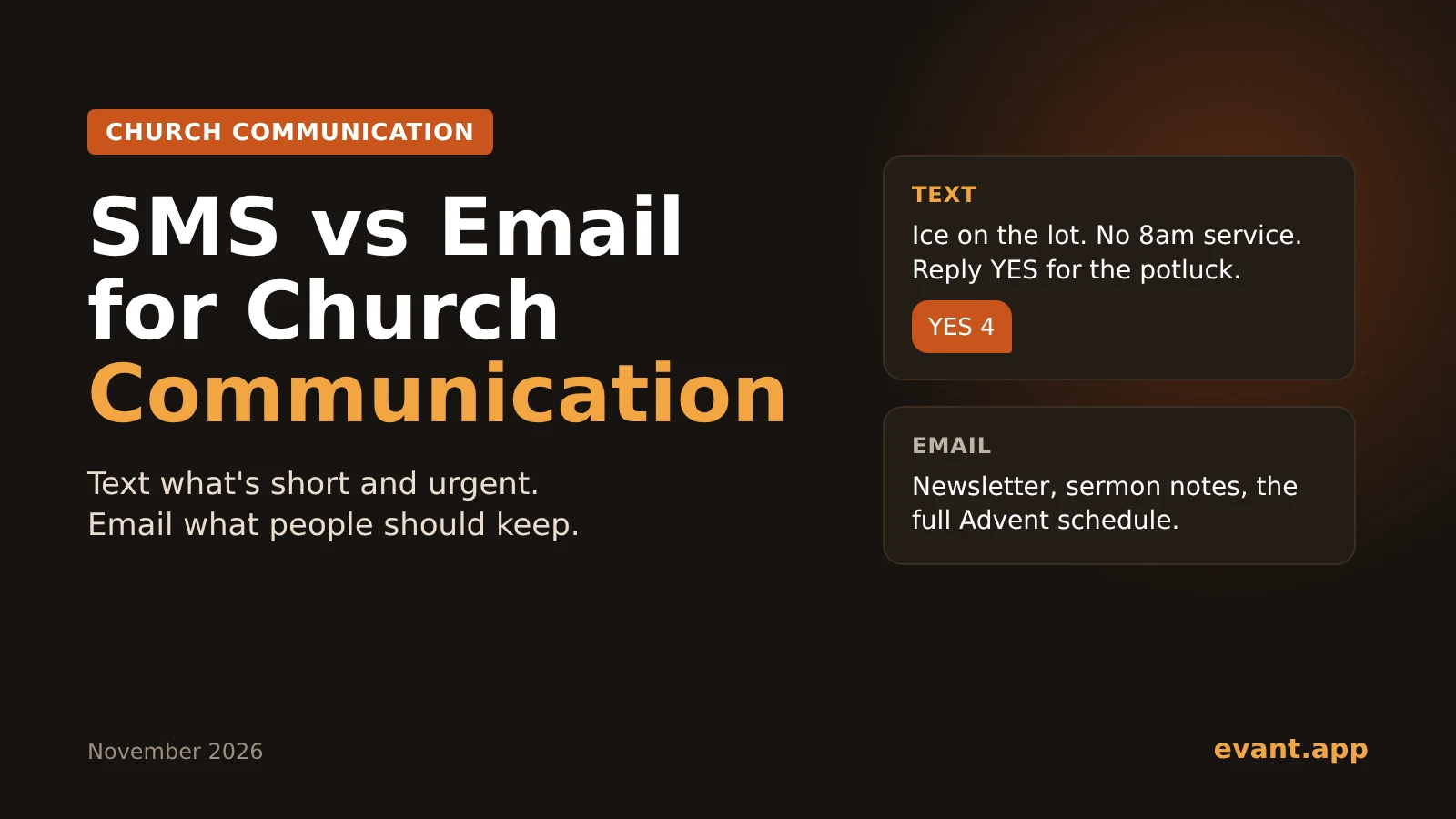
SMS vs email for church communication comes down to one rule: text anything short, urgent or that needs an answer, and email anything long that people should keep. Reminders, closures, prayer chain alerts and RSVPs go by text. The newsletter, sermon notes and the full event details go by email. Texting reaches more phones (Pew's 2026 survey found 98% of U.S. adults own a cellphone, and 91% own a smartphone), while email gives you room and costs less per message.
Most churches don't need to pick one. They need to stop sending the wrong message down the wrong pipe.
Here's a worry I hear from pastors all the time. "Won't texting our people feel spammy?"
My honest answer: email already sounds more spammy. Think about what lands in your own inbox on a Tuesday.
Full disclosure: I run Evant, a texting tool for churches, shuls and nonprofits. It includes free email too, so I don't have a reason to trash either one. Facts and prices checked November 2026.
The short version
- Text it if it's under a couple of sentences, time-sensitive, or you want a reply.
- Email it if it needs paragraphs, photos, attachments or a link people will come back to.
- Call it if the person only has a landline. Some of your most faithful members do.
- Get permission first for texts. Email has rules too, but texting rules are stricter.
Think of email as the church bulletin and a text as a tap on the shoulder. You need both. You just don't tap someone on the shoulder to hand them a four-page bulletin.
SMS vs email for church communication, side by side
Is the "98% open rate" the real reason to text?
No. And I'd stop leaning on it.
Almost every article ranking for this question quotes some version of "98% of texts are opened, 20% of emails are." The best-known one, on Carey Nieuwhof's site, traces it to a Gigaom piece from 2015 and was written by a marketer at a texting company. That doesn't make it wrong. It makes it old, and it measures opens, not action.
Here's a better reason, from a source you can check. Pew Research Center's 2026 mobile fact sheet says 98% of U.S. adults own a cellphone and 91% own a smartphone. That gap is roughly 7 in 100 adults with a phone that can get a text but probably isn't reading church email on it.
Not everyone has a smartphone. Not everyone has data. Not everyone checks email.
Almost everyone can read a text.
What should a church send by text?
Anything where the timing matters more than the detail.
- Day-of reminders. "Choir practice moved to 6:30 tonight."
- Closures. "Ice on the lot. No 8am service. 10:30 is still on."
- Prayer chain alerts. Short, private, fast.
- Volunteer gaps. "Need two more for the nursery Sunday. Reply NURSERY."
- RSVPs. "Advent potluck Dec 13. Reply YES and how many." People answer, you get a count.
That last one is where email loses hardest. Asking people to click a link, open a form and type their name is a lot of steps. A reply is one. I wrote more about that in why SMS beats email clutter for RSVPs.
December is a good month to test this. Here are Christmas church text message templates you can copy. And for members with only a landline, a short recorded call does what a text does. I priced that out in voice broadcast for churches.
What should stay in email?
Anything people need to read twice.
- The weekly newsletter with photos.
- Sermon notes and study guides.
- The full schedule for Holy Week or a retreat.
- Anything with an attachment or a form people fill out at home.
I'll walk back my own argument a little here. I've argued that nonprofits lean too hard on email, and that an email list you hit with regular campaigns can burn out in about three months as messages slide from the inbox to promotions to spam. But older major donors still use email. I've said that too. Email is part of the answer. It just isn't the whole answer.
So keep the newsletter. Then text a one-line nudge that it went out.
Is texting your congregation spam?
Not if they asked for it. That's the whole line.
A lot of church leaders tell me texting feels spammy, annoying, or buried in regulations. The rules are real, but they're simple:
- Get opt-in. A connect card checkbox or a "text JOIN to" sign-up. The FCC's telemarketing rules under the TCPA are why consent matters.
- Honor STOP right away. Carriers expect it, per the CTIA messaging principles.
- Register your number. Mass texts from a regular 10-digit number need A2P 10DLC registration. Many texting tools help with it. Evant handles it for you.
- Send when people want it. Common advice says automate everything and send on a schedule. I disagree. A text should be personal and arrive when the person would actually want it. Saturday night for Sunday. Not 6am Monday.
What does each one cost a church?
Email is cheaper per message. That's just true.
Mailchimp's free plan covers up to 250 contacts, and it offers nonprofits a 15% discount on paid plans. Bigger lists pay by contact count.
Texting costs something every time. Every person on the list is a message. Long texts can count as two. Run yours through a free SMS character counter before you hit send.
Where it gets silly is paying for two tools that don't talk to each other. Evant plans start at $20 a month, and email is included free with templates, custom designs and scheduling. Texts, voice calls and email sit in one dashboard. Free trial, no credit card.
A simple week that uses both
- Tuesday: the email newsletter goes out with the full week.
- Thursday: one text to the volunteer group. "Reply YES if you can still serve Sunday."
- Saturday evening: one text to everyone. "See you tomorrow at 10. Coffee's on."
- Sunday at 7am, only if needed: a closure text, plus a short call to landline-only members.
Two texts a week. That's it. If you're setting up your first send, start with how to send a mass text to your congregation, and see the full church text messaging guide for the bigger picture.
FAQ
Is it better to text or email church members?
Text for short, urgent messages and anything that needs a reply, like reminders, closures and RSVPs. Email for long messages people will keep, like newsletters and sermon notes. Most churches get the best results using both, each for its own job.
Do church members prefer text or email?
It varies by person, so ask on your connect card. Pew Research Center's 2026 survey found 98% of U.S. adults own a cellphone and 91% own a smartphone, so a text reaches nearly everyone, while email works best for members who check it regularly.
Can a church text members without permission?
No. Get opt-in first, through a sign-up form or a text-to-join keyword, and stop texting anyone who replies STOP. Consent rules come from the FCC's TCPA rules and carrier guidelines, and mass texting from a 10-digit number also requires A2P 10DLC registration.
Should texting replace the church email newsletter?
No. Keep the newsletter for detail, photos and links, and use a short text to point people to it or to share what's urgent. Texting works best as a nudge, not a replacement.
So should your church text or email?
Both. Email tells the story. Texts get people to show up.
If you only fix one thing this month, move your reminders and RSVPs to text and leave the newsletter in email. Watch who replies.
At the end of the day, the right channel is the one your people will actually read in time.
👉 Start your free trial. No credit card.
Related Blogs

Tithely Messaging Pricing 2026: No More $19 Plan, What Texting Really Costs Now
Michael PedoeemTithely Messaging no longer has a $19 plan. Texting now comes with $72 Church Management or $119 All Access: 250 texts, then 1.9¢ each.
Breeze ChMS Texting in 2026: 250 Free Texts, One-Way Messages and When to Add a Texting Tool
Michael PedoeemBreeze ChMS texting gives you 250 free texts, then 1.9¢ each. Here's the fine print, why members can't reply, and when to add a texting tool.
Text-Em-All vs Clearstream for Churches: Pay per Person or per Text? (2026)
Michael PedoeemText-Em-All charges by group size and includes calls. Clearstream charges by credits and fits Planning Center churches. What a 150-person church pays.





Get the Evant app



