
The Shift to Mobile-First Event Engagement
Most organizers still rely on email invitations or clunky web forms, only to watch half their invite list ignore the message. Between the spam filters that bury your invite and the friction of clicking a link to load a separate page, your RSVP rates end up suffering from outdated infrastructure.
This manual data entry drains your time, but it does not have to be this hard. While traditional digital forms often lead to drop-offs, evant.app creates a seamless experience where guests respond directly within their text thread. When you replace passive collection with mobile-first communication, you turn a forgotten task into an active conversation that drives higher attendance.
Open Rates: SMS Dominates Email

Most email campaigns suffer from poor visibility. While email open rates hover around 20%, SMS open rates consistently reach 90% to 98%. This massive disparity stems from how users interact with their mobile devices compared to overcrowded email inboxes.
The speed of engagement is equally distinct. Roughly 95% of text messages are read within 3 to 5 minutes of delivery. This creates a reliable channel for time-sensitive notifications, such as last-minute logistical changes or urgent event notifications. Unlike email, where important messages often disappear into filters or generic promotions tabs, SMS reaches the recipient through a personal notification system that is prioritized by the user.
Using Evant, organizations can move beyond static email blasts and ensure their invitations arrive directly on the handset without the latency or delivery barriers common to traditional digital methods. When a nonprofit or school group relies on email, they are competing with spam folders and day-old notifications. By contrast, an automated SMS program treats every event interaction as a high-intent, immediate conversation. This is why evant.app positions text messaging as the primary tool to turn silent guest lists into active community participation.
Higher Conversion Rates Through Frictionless RSVPs

Most organizers still rely on email invitations or web forms, often watching as half their invite list ignores the message. The disconnect lies in the friction caused by requiring guests to click a link, wait for a page to load, and then navigate a form that rarely auto-saves their data. It is a slow, cumbersome process for an invitation that deserves a quick answer.
This is where evant.app) changes the math. By using conversational SMS workflows, events gain a significant advantage. SMS RSVPs often achieve higher response rates than email because they strip away the technical overhead. Instead of leaving their messaging interface, a guest simply replies with a keyword like YES, transforming a multi-step chore into an immediate, one-tap interaction.
These text-based systems treat the RSVP as a conversation rather than a data entry task. This shift respects the guest's time and provides organizers with clean, real-time data that automatically populates their attendee list. Creating a frictionless experience is not just about convenience. It is the most effective way to ensure your community actually shows up.
Building an Effective SMS RSVP Workflow

How can organizations implement a simple and effective SMS RSVP process? Success begins with removing friction. Instead of forcing guests to open emails or navigate browser-based forms, an SMS RSVP workflow allows attendees to confirm with a single reply.
For medium to large events, manual tracking in spreadsheets leads to inevitable errors. Using a dedicated SMS platform ensures that every response is logged in a centralized CRM. This integration automatically tracks attendance, captures dietary requirements, and updates donor records without administrative staff ever needing to touch a data entry field.
Compliance is the final layer of a professional nonprofit SMS program. By using an established service provider, you manage opt-ins and honor 'STOP' requests according to industry regulations, a task that remains risky and unscalable when using personal mobile devices for mass event coordination.
Real-Time Data and Centralized Management
Struggling with fragmented guest lists is a reality for most organizers. Managing responses across disconnected email chains, messy paper forms, and stray voicemails leads to an administrative nightmare where accurate headcounts remain elusive until the final hour. This manual data entry process is not just tedious. It is the primary cause of errors that lead to over-catering or seating shortfalls.
The Evant platform solves this by providing instant data synchronization. When a guest replies via text, their status flows immediately into a central dashboard. This eliminates manual spreadsheet management and ensures your records are always current, regardless of how many guests are interacting with your event.
Advanced tools like Evant also offer deep CRM integration, allowing you to attach engagement data directly to attendee profiles. Unlike static forms that discard information after submission, these systems maintain a historical record of participation. This data allows for more personalized outreach later, as organizers can segment their lists based on actual behavior rather than assumptions.
What are the primary benefits of using SMS messaging for community and event engagement?
SMS messaging serves as an exceptionally direct communication channel, boasting open rates that consistently exceed 90% and allowing organizations to reach supporters instantly. For nonprofits, this immediacy is vital for streamlining time-sensitive event logistics, such as sending last-minute venue updates, facilitating swift RSVPs, and coordinating check-ins. Beyond simple event management, SMS acts as a powerful tool for community cultivation, enabling organizations to nurture deeper relationships through personalized, two-way interactions that encourage active participation. Research shows that organizations leveraging text strategies for donor engagement often see significant improvements in results, including higher average gift amounts when cultivation precedes a solicitation. By building an opted-in mobile list, organizations create a reliable, high-impact pipeline for sharing meaningful updates and fostering a consistent, mobile-first community presence.
Cost Considerations for SMS vs. Digital Forms
Managing a mailing list has traditionally meant eating the cost of physical invitations. Paper cards, high-quality printing, and the rising expense of postage add up quickly. If an address is incorrect or a letter gets lost, you lose both the money spent on that unit and the opportunity for a high-value engagement.
By comparison, digital tools offer a far more predictable budget. While most platforms charge small subscription fees, the variable cost for a text message usually sits between $0.01 and $0.05. Digital tools allow organizers to bypass the $0.60 to $1.00 postage cost per piece while gaining real-time data tracking that paper cannot replicate.
What are the typical cost considerations when choosing an SMS communication strategy for community engagement? When planning your SMS communication strategy, costs generally range from $0.01 to $0.05 per message, though total investment depends on factors like message length, carrier fees, and whether you choose standard SMS or more engagement-heavy MMS. Beyond per-message rates, nonprofits should account for platform subscription fees, which provide access to essential features like automated event reminders, CRM integrations, and advanced analytics. Some providers may also charge for dedicated short codes or registration fees required to ensure high message deliverability and compliance across networks. It is crucial to evaluate these baseline costs against the potential for higher event participation and donor engagement, as effective SMS tools often deliver significant ROI for community outreach. By balancing these variable and fixed costs, organizations can build a sustainable, scalable strategy that effectively streamlines logistics and keeps community members connected.
Two-Way Communication That Builds Community
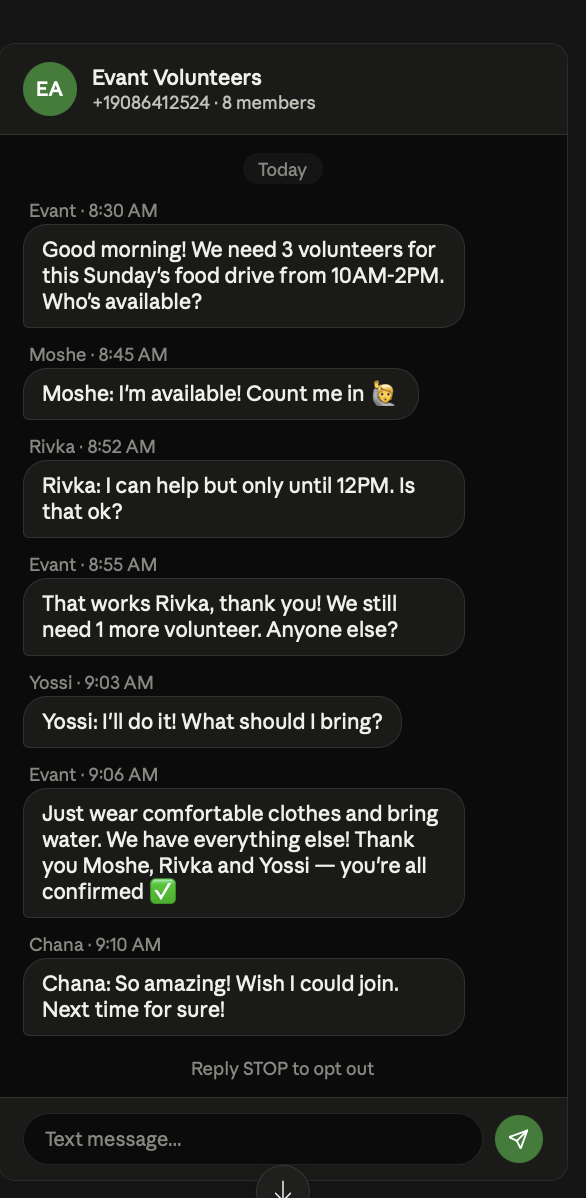
Most organizations view invitations as a one-way street, pushing information out and hoping for silence followed by a headcount. This approach misses the most important part of community building. True interaction requires a loop, where an invite is not the end of the conversation but the beginning.
When guests can simply reply to ask about parking or share dietary needs in real time, they feel heard. Platforms like evant.app enable this level of high-touch service at scale, moving beyond static, clunky web forms that frustrate users on mobile devices.
The impact on operations is measurable. For instance, Chabad at Binghamton successfully leveraged SMS automation to process nearly 100,000 RSVPs. By using an interactive flow, they freed up their team to focus on meaningful donor relationships rather than sorting through email threads or manual paperwork.
Using SMS as a cultivation tool transforms your outreach. Because 90% of text messages are read within three minutes, the feedback loop for donors and volunteers becomes nearly instantaneous. It creates a rhythm of interaction that builds trust month over month.
Scalability and Automation for Growing Events
Managing a small dinner party is simple, but moving to an event with hundreds or thousands of attendees turns manual tracking into a full-time job. Many organizers try to stay afloat using spreadsheets or public sign-up forms, only to find themselves drowning in duplicate entries and human error. Evant changes this dynamic by moving from manual coordination to automated, mobile-first logistics.
Platforms that handle thousands of RSVPs without manual effort provide the infrastructure to scale without adding headcount. For example, Evant processes massive datasets while keeping individual threads organized. This level of automation is essential, as the healthcare sector has shown that automated reminders can reduce no-show rates by approximately 38%.
True scale requires more than just mass-blasting generic messages. Using segmented targeting allows organizations to maintain a personalized feel even when the list reaches thousands. By grouping guests based on their specific relationship to the event, organizers can send tailored information rather than one-size-fits-all broadcasts. This precision ensures high engagement because every recipient sees an invitation that feels relevant to them.
Compliance and Best Practices for SMS Outreach
Skipping basic compliance and legal landscape is the fastest way to kill your organization's reputation. When you blast messages to an unverified list, you run directly into TCPA and CTIA regulations designed to protect consumers from spam. A strong SMS engagement platform integrates consent management tools directly into your workflow. This ensures that every opt-in matches GDPR standards for clear, explicit permission, shielding you from the legal fallout that often hits amateur outreach efforts.
List hygiene is not just about keeping your account active, it is about respecting boundaries. If your bounce rate climbs above a few percentage points, carriers will start flagging your ID as unreliable. An automated system handles unsubscribes instantly, maintaining your deliverability and keeping your organization on the right side of the law.
Why Text Always Wins for RSVPs
Email sits in crowded inboxes, often ignored or buried under noise. Text messages bypass this clutter, hitting handsets with a 98% open rate while requiring no active internet connection to receive. Organizations relying on manual spreadsheets or clunky web forms often suffer from low engagement, but shifting to SMS transforms this process.
Using Evant.app allows organizers to move beyond basic invitations, replacing friction-heavy digital forms with simple, two-way text sessions. While traditional methods like paper cards or email campaigns drain resources and stall, mobile-first workflows provide real-time updates and automated headcount tracking that scale effortlessly from a small dinner to a community event of thousands.
Adopting text-to-RSVP strategies puts your community's actual needs at the center of event logistics. By meeting attendees where they already spend their time, you eliminate barriers to entry and drive higher turnout. Organizations that make this switch see measurable gains in engagement and return on effort, proving that mobile-first is no longer optional—it is the standard for modern, effective community management.
Related Blogs